


The timing chip strap is the last piece of race gear most triathletes think about. You pick it up at packet pickup, drop it in the bag with your bib and swim cap, and strap it on before sunrise. It sits under your wetsuit. You forget it until you cross a timing mat.
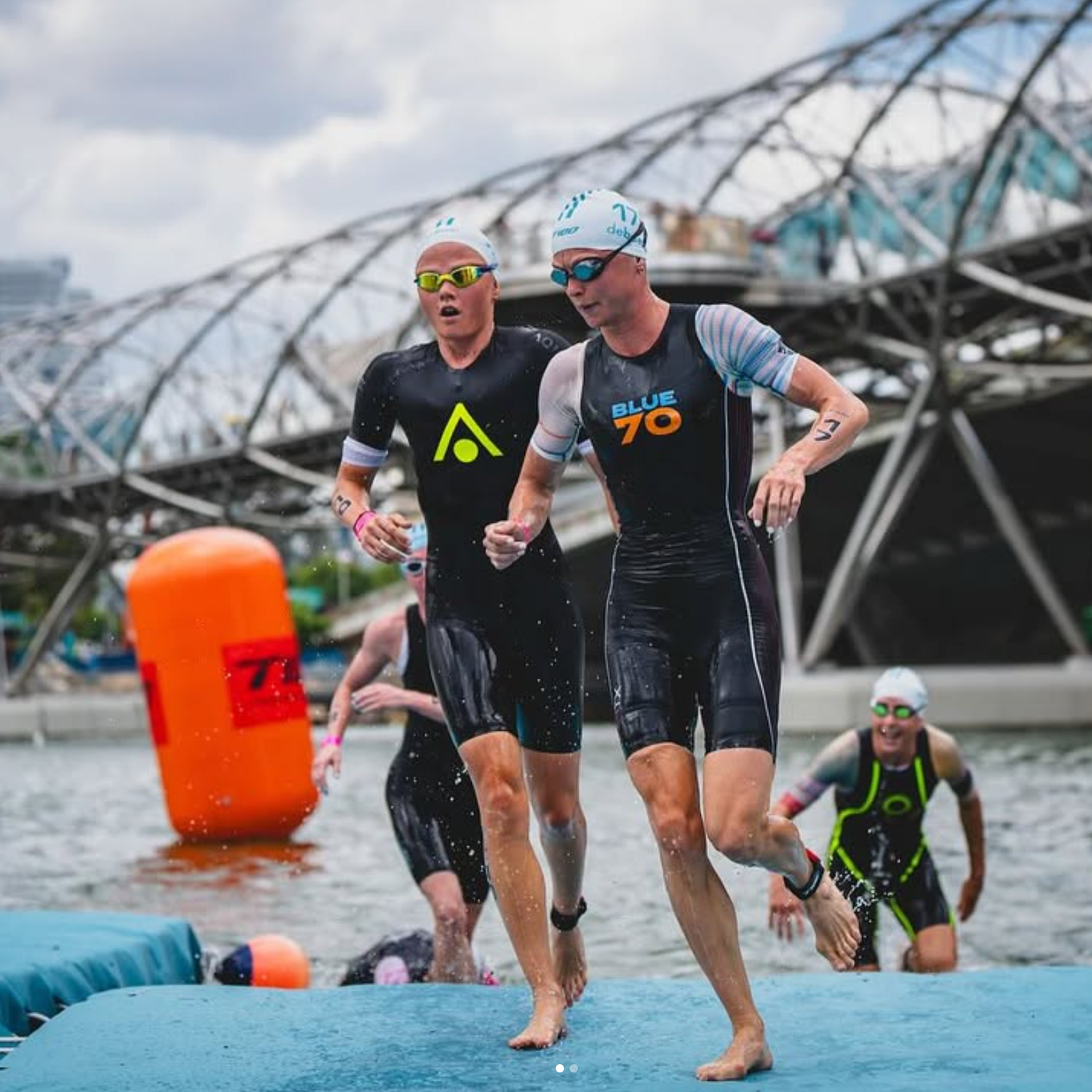
For a wetsuit swimmer, that strap changes how the suit goes on and how it comes off. The neoprene cuff has to stretch over the plastic pod when you pull the suit on and slide back over that same pod at T1. A strap that felt harmless at packet pickup can become a problem by the first buoy. If the cuff lacks stretch or sits too tight, the pod presses into your ankle bone, and in cold water you may not notice until the suit won't release in transition.
Putting the Suit On Over the Strap
Race instructions vary. If yours call for the strap on before the wetsuit, set the band so you can slide one finger underneath. Position the pod on the flat part of your ankle, not over the bone. Draw the suit over your foot with the pads of your fingers. Don't pinch the neoprene with your fingernails. Fingernail punctures are one of the most common damage patterns we see, and they aren't covered under the one-year Blue70 warranty. When you pull the cuff over the strap, use your palm or the side of your hand to ease it past the pod.
Taking the Suit Off After the Swim
Wetsuit removal goes wrong at the ankles more than anywhere else. You unzip, peel the top, roll the suit to your knees, then try to pull the leg off by the hem. If the timing chip is still under the neoprene, that hem catches on the pod. Keep the strap on. Roll the suit down from the knee, then slide a thumb inside the cuff to lift it over the strap. The suit should release in one motion.
Practice that sequence once before race week. Wear the same strap and the same suit you plan to race in. A living room rehearsal won't feel like wet neoprene, but it builds the order.
Use the Strap as an Ankle Fit Check
Most triathletes check wetsuit fit through the chest, shoulders, and hips. They skip the ankle. That's a mistake. A suit can fit everywhere else and still bind at the cuff once a timing chip is under it. Blue70 fit guidance says a wetsuit should feel snug on dry land and more comfortable in the water. Apply that same test to the ankle. Put the strap on, pull the cuff over it, and flex your foot from toes up to toes down.
A swim-specific suit should let the ankle move without the cuff bunching behind the Achilles. If the pod digs in when you point your toes, the cuff is too tight for race conditions. Every kick cycles the ankle through dorsiflexion and plantarflexion. A cuff that resists that motion adds tension where you don't need it, and a timing chip pod gives that tension a hard edge.
- The pod digs into your ankle when you point your toes.
- The cuff bunches behind your Achilles during the kick.
- The suit hangs up on the strap when you peel it off.
Any one of these means the cuff is working against the timing chip, not with it.
Blue70 suits use Yamamoto neoprene in 38, 39, and 40 cell. Higher cell numbers mean more flexibility. A cuff with more flexibility moves with the ankle instead of fighting it. Rub the cuff between your fingers before you buy. If it feels noticeably stiffer than the upper leg panels, think about how it will behave over the strap on race morning.
Women-Specific Ankle Patterns Change the Test
For female athletes, lower-leg fit is where a unisex suit often shows its limits. The Blue70 Femme Fit pattern refines the bust, torso, wrist, and ankle areas on every women's wetsuit. A cuff cut for a woman's ankle sits differently than a unisex pattern. That difference becomes obvious with a timing chip strap in place. If suits have fit you through the body but felt tight at the ankle, a women-specific pattern solves that without sizing up or down blindly.
Sizing up to relieve an ankle cuff introduces extra material through the rest of the leg. That extra material changes how the suit sits in the water. A pattern built for the ankle is the better fix.
Why the Ankle Still Matters
Timing technology has moved toward slimmer, softer straps over the years. The basic interaction hasn't changed. A hard plastic pod still sits under a stretchy neoprene cuff. Race directors may eventually move timing to a different body part, but for now the ankle remains where the suit meets race timing. That makes lower-leg fit as important as shoulder flexibility. A strap that sits flat and a cuff that peels cleanly are two halves of one race-morning problem.
Practice Before Race Week
Before your next race, add the timing chip strap to your wetsuit test. The Blue70 Test Swim program lets you swim in a suit and still return or exchange it if it comes back clean, dry, and unmodified. You get 30 days from the ship date to make that exchange. Use that window to rehearse donning, the ankle peel, and T1 with the strap in place. Happy swimming.