


Race week always has one number that changes the conversation. Water temperature. The official reading decides whether the swim is wetsuit legal, optional, or non-wetsuit. It also shapes what goes into your transition bag and how you sleep the night before. The reading announced at the athlete briefing comes from one spot, at one time, measured under a specific protocol. It cannot describe what you will feel at the far turn buoy or in a deep channel.
Most athletes treat that number like a verdict. Race day is already full of small decisions, and this one feels big because it arrives late. Some races confirm the wetsuit ruling only on the morning of the swim. If your plan relies on a single afternoon reading from a weather site, you have built your race on a narrow foundation.
Why Ironman has wetsuit rules in the first place
A wetsuit changes what happens to your body in the water. It adds buoyancy, lifting your hips and legs. Buoyancy equals speed in the water because a lifted body position cuts drag. The suit also traps a thin layer of water against your skin. Your body warms that layer, and the suit holds it close. Wetsuits are not waterproof by design.
Race organizers set wetsuit-legal temperature rules to balance heat safety and competitive fairness. In warm water, a full wetsuit can push your core temperature higher over a 2.4-mile swim. In cool water, the same suit helps retain heat and provides added thermal protection. Both the performance edge and the heat risk scale with water temperature and time in the water.
The specific cutoffs are not set in stone. They change between seasons and sometimes between venues. The only cutoffs that matter on race day are the ones published in your athlete guide, confirmed by the race director at the briefing. Read the guide as soon as it posts. Contact the race director if the wetsuit section is not clear.
At blueseventy, our team has watched this system develop from the inside. In 1993, the company that became blueseventy developed one of the first triathlon wetsuits and became the official wetsuit of the Ironman triathlon. The suit line was renamed Ironman Wetsuits. Those early suits were thicker and less swim-specific. Race organizers adjusted rules as suits became faster and more specialized. Today's temperature rules sit on top of decades of that back-and-forth between equipment design and race governance.
What a single reading misses
Shallow water warms faster than deep water. A dark lake bottom absorbs more sunlight than a sandy one. Wind can push warm surface water away from the course. Currents can mix colder water upward. Two points on the same course can differ enough to change how your suit feels. The official reading may not match the water where you will swim.
Matching a suit to the water range you will actually swim
Think of the water range, not the solo reading. Blueseventy wetsuits are swim-specific. They use Yamamoto neoprene in 38, 39, and 40 cell. A higher cell number means more flexibility. The pattern work prioritizes shoulder rotation and body position for swimming, not surfing or scuba.
Below about 56 to 58 degrees Fahrenheit, a purpose-built thermal suit adds meaningful warmth. The Thermal Reaction is fully lined with a Zirconium jersey. That lining traps more warm water against the skin. If your race sits in this range and the swim is wetsuit legal, this suit is the natural pick for longer exposure. Cold water swimming asks more of you than gear. Acclimatize gradually, swim with a group or safety crew, and never treat a wetsuit as a personal flotation device.
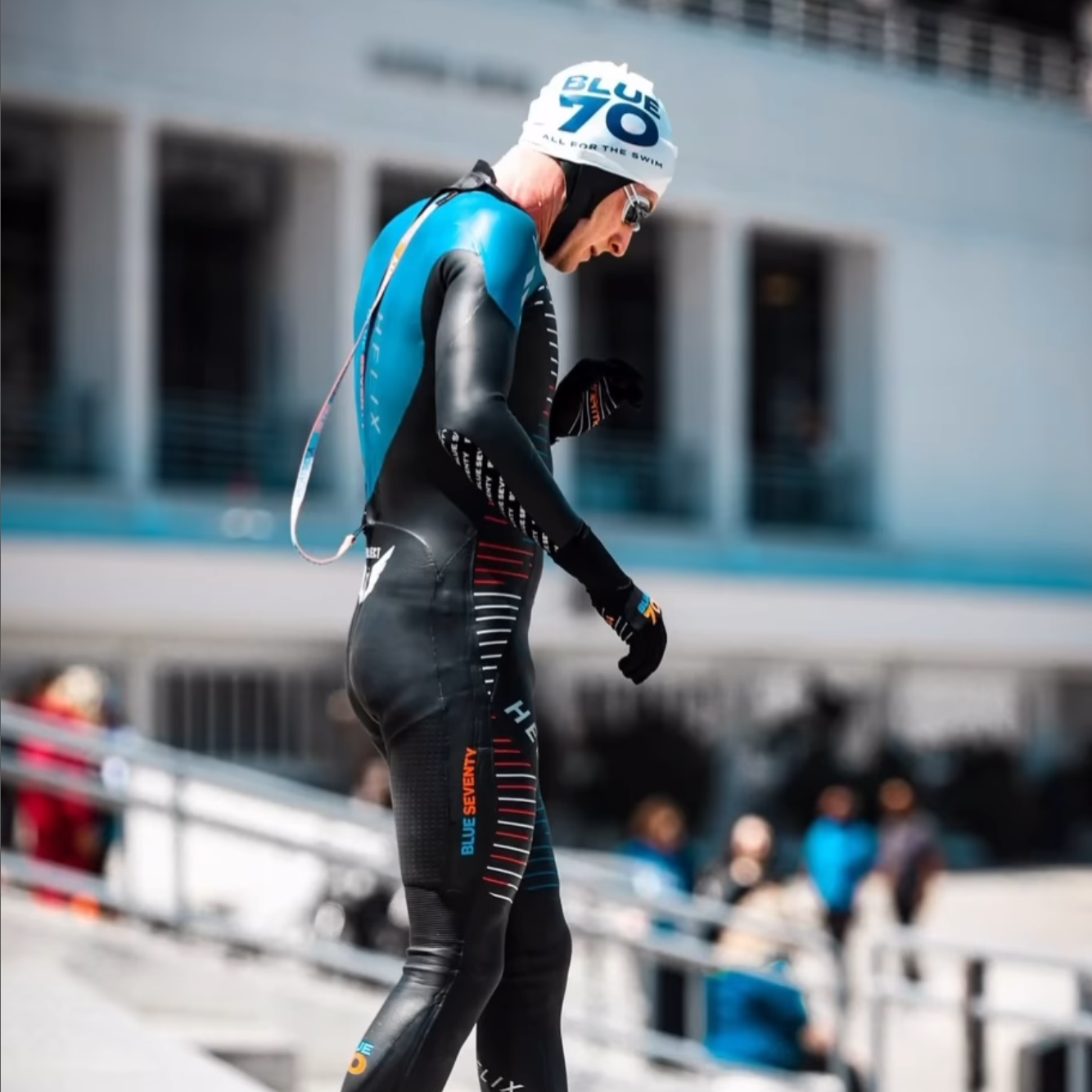
Roughly 58 to 70 degrees is the full-suit window for most swimmers. The Reaction uses a higher-grade neoprene for frequent, longer swims. The Fusion has the lower-sitting neckline from its 2021 redesign, which many athletes prefer for shorter, repeated sessions. The Helix remains the flagship race-day suit. Its thin, flexible neoprene in the shoulders, LIFT buoyancy panels, and permeable catch panel support feel for the water. That thin neoprene does not suit heavy training use, and we say that openly.
Above about 70 to 72 degrees, a full suit can feel too warm over a long swim. A sleeveless suit or a swimskin becomes the better move if the rules allow it. The Reaction Sleeveless keeps body buoyancy but frees the arms. A swimskin adds little warmth and keeps a smooth outer surface for reduced drag.
Race week packing starts before you know the ruling
Check the water temperature early in race week, again at check-in, and again at the race briefing. The official ruling can arrive late. Some races confirm the decision on the morning of the swim. This is not the time to test a new suit.
If you buy a wetsuit in race week, you can still swim in it and exchange it if the fit is not right. Blueseventy's Test Swim policy lets you swim in a wetsuit and still return or exchange it within 30 days if it is clean, dry, and unmodified. That removes the biggest fear for first-timers: a suit that feels fine on land but fights you in the water.
- Pack a full wetsuit if the water is likely to land in the legal range.
- Pack a swimskin if the race could go non-wetsuit.
- Bring both if the forecast straddles the cutoff.
- Bring your goggles and cap for every scenario.
Train for the non-wetsuit swim
Many age-group swimmers do every open water session in a full wetsuit. That builds fitness and a specific feel: hips high, legs lifted, less kick. A non-wetsuit swim feels different. The legs sit lower, the kick matters more, and sighting changes because your body position shifts.
Add one non-wetsuit open water swim per cycle if your race has any chance of a non-wetsuit ruling. Keep the first sessions shorter. Pay attention to your kick and your sighting rhythm without the suit's buoyancy.
If you want partial support while still training the non-wetsuit feel, the LIFT Buoyancy Short adds targeted buoyancy without arm or chest coverage. Use it as a training support to hold a better body position while you build the strength to hold that position without assistance. It does not function as a personal flotation device.
The athlete guide holds the authority
Do not rely on forum threads. The current wetsuit-legal temperature cutoffs live in the athlete guide for your event. Those numbers change between seasons and sometimes between venues. Read the wetsuit section the day the guide posts. If anything reads as unclear, email the race director.
The race director's official ruling trumps every app, weather service, and pre-race video. Race briefings remain the final word. The reading you see on Tuesday may not be the reading that governs Sunday.
Plan for the range
The water temperature rule is a decision input. Use it to shape your gear and your training, but do not treat the announced number as a guarantee. Prepare for the range. Pack for both rulings. Train your body to swim well with and without the suit.
If you are still dialing in your wetsuit fit, take a test swim. You can swim in it, return it if it is not right, and walk into race week with one less variable. All for the swim.