


Ask any petite swimmer about her wetsuit history and the same complaints come up: water pooling at the neck, fabric bunching at the waist, shoulders that give out long before the legs do. The usual explanation is that she's "hard to fit." That's not quite right. The real problem is that most wetsuit sizing starts with a height-and-weight chart, which treats a smaller body as a shrunken version of an average one. Bodies don't work that way.
Proportions shift as height decreases. A swimmer who's 5'2" and 115 pounds doesn't have a torso, shoulder width, and wrist circumference that are simply smaller copies of a swimmer who's 5'8" and 145 pounds. The ratios change. Torso length compresses faster than height would predict. Shoulder width narrows at a different rate than the chest does. None of that shows up on a chart that only asks for height and weight.
What Goes Wrong When a Pattern Is Just Scaled Down
Take a mid-size wetsuit pattern and shrink it uniformly, and three specific problems show up in the water.
- Extra fabric collects at the torso. A shortened but unreshaped panel leaves slack at the midsection, and slack fills with water. That trapped water doesn't insulate anyone; it just adds weight that has to move with every stroke.
- Shoulder seams sit too low. When the torso panel runs longer than a swimmer's actual trunk length, the seams drop below the shoulder joint. Every catch and recovery then works through extra material, and fatigue shows up in the deltoids well before the swim is finished.
- The neckline gaps. This is the complaint petite swimmers raise most often, and it's usually mistaken for a style preference. It isn't. A neckline built for a larger neck circumference simply won't close against a smaller one, and that gap is what lets water flush in on entry, then keep flushing in with every breath.
A Petite Pattern Is a Different Design, Not a Smaller Number
A wetsuit built for a petite frame isn't the smallest size on a standard chart. It's a distinct pattern block that adjusts torso length, shoulder width, and wrist and ankle circumference together, rather than trimming one measurement at a time and hoping the rest falls into place.
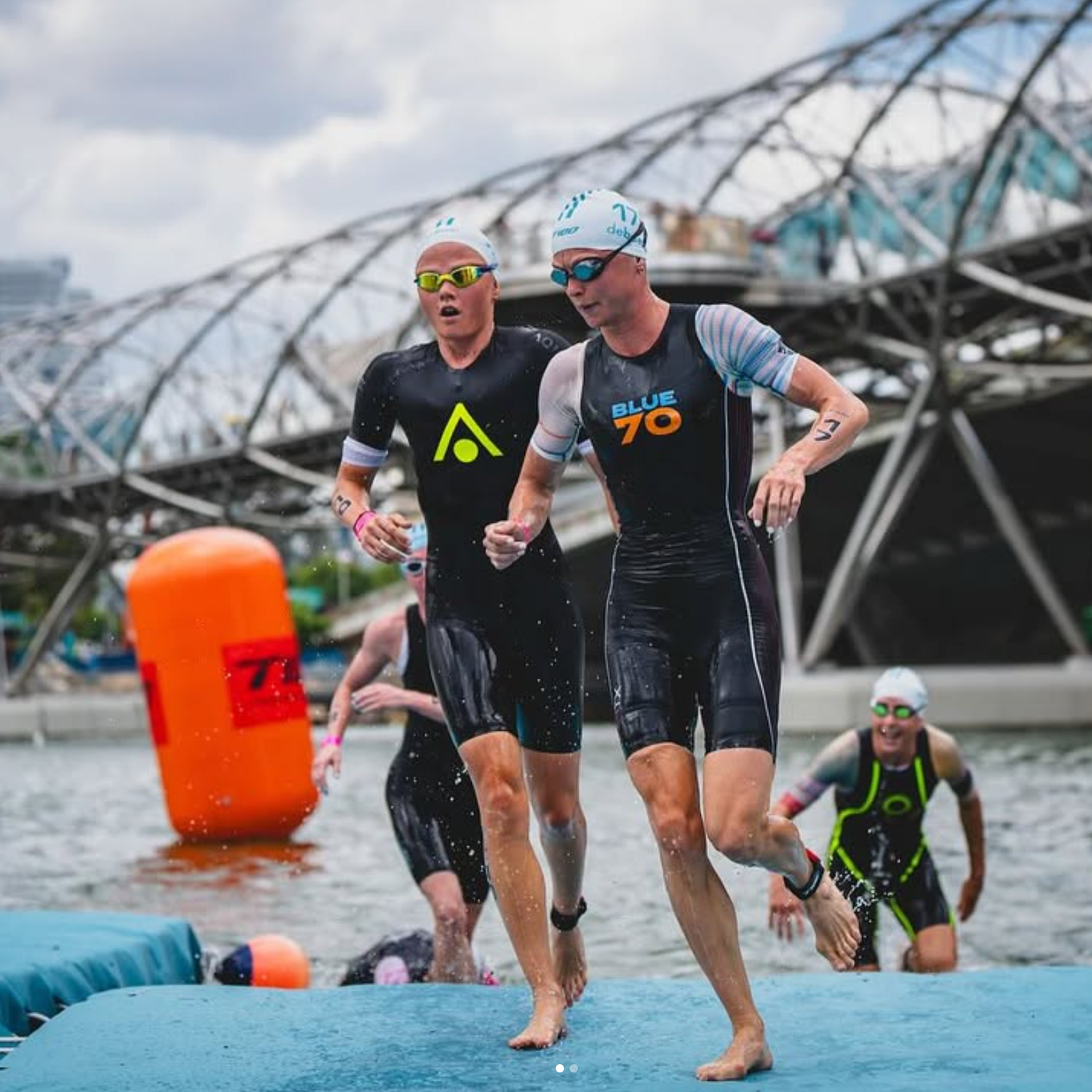
Blue70's Femme Fit line was built on that premise. The pattern refines fit through the bust, torso, wrists, and ankles, and lowers the neckline specifically to cut down on gapping and chafing. It also extends the zipper opening, which matters more than it might sound. A longer zipper makes it possible to get a genuinely snug torso fit without turning entry into a wrestling match, and it saves real seconds during a transition when every second counts.
This isn't a recent add-on, either. Blue70 introduced Femme Fit roughly 15 years before writing its own company history, and expanded it to 15 distinct sizing options in 2014. That's years of pattern refinement across a range of body types, not one small-medium-large scale stretched to cover everyone.
Why "Snug" Feels More Intense on a Smaller Frame
Fit doctrine across wetsuit design generally agrees on one point: a suit should feel snug on dry land and more comfortable once you're submerged, because water pressure and buoyancy change how neoprene behaves against the body. On a petite frame, that shift can feel more dramatic. There's less body mass to fill the neoprene's designed compression, so a suit that runs even a little large has more room to shift once a swimmer becomes buoyant in open water.
This is where sizing anxiety often points in the wrong direction. A petite swimmer who feels a suit is uncomfortably tight in a shop is often reacting to memories of past suits that were actually too loose once she got in the water. Sizing up doesn't fix that. Finding a suit whose base pattern was built for a narrower shoulder and shorter torso does.
Buoyancy Placement Doesn't Scale Down Evenly Either
Buoyancy equals speed. That's the foundational physics behind every triathlon wetsuit: neoprene lifts the hips and legs, correcting body position and cutting the drag created by a lower body riding too low in the water. But buoyancy panels are placed based on where a standard-proportioned swimmer's hips sit relative to the shoulders. On a shorter torso, that placement can land in the wrong spot, under-supporting the hips or creating uneven lift that a swimmer ends up correcting for with extra kick effort.
This is one of the less obvious reasons some petite swimmers say a wetsuit fights their stroke instead of helping it. It's rarely about strength or technique. It's a mismatch between where the suit places its lift and where the swimmer's own center of buoyancy actually sits.
How to Actually Size for a Petite Frame
A few changes to the usual buying process make a real difference.
- Size by torso length before height. Two swimmers of identical height can have meaningfully different trunk lengths. If a size chart includes torso measurements, use that as the tiebreaker over the overall height number.
- Check the neckline bent forward, with your head turned. Neckline gapping shows up during the breathing motion. Standing straight in front of a mirror won't reveal it.
- Test the shoulder seam with a full arm extension. If the seam sits below your shoulder joint when your arm reaches all the way forward, that's a length mismatch no amount of dry-land tugging will fix.
- Take a Test Swim before deciding. True fit on a petite frame is hard to judge on land. Blue70 lets customers swim in a wetsuit and still return or exchange it, as long as it comes back clean, dry, unmodified, with tags and accessories attached. That policy exists because buoyancy behavior and seam placement only reveal themselves once you're moving through water.
Fit Is a Training Variable, Not Just a Race-Day Detail
There's a training consequence here too. A shoulder seam that sits even slightly wrong adds a small amount of resistance to every stroke. Over the length of a long open-water session, that resistance compounds. It doesn't just leave you tired at the finish; it can gradually reshape your stroke mechanics as your body compensates for the added drag. Getting torso and shoulder proportions right isn't only a race-day concern. It's a tool that keeps your stroke honest across an entire training block.
The Bottom Line
Petite sizing isn't a smaller number on the same chart. It's a different set of proportions, applied consistently from the neckline down to the ankle cuff. If you've dealt with bunched fabric, shoulder fatigue, or a neckline that never quite seals, that's very likely a scaling problem in the pattern, not a fit failure on your part. A pattern built specifically around shorter torso length and narrower shoulder width, like Blue70's Femme Fit line, solves that at the design level instead of asking you to compensate for it stroke after stroke.
Not sure where you land? Start with Blue70's size charts and fitting guide, then take advantage of the Test Swim policy to confirm the fit where it actually matters: in the water.