


Every fall, the same thing happens in garages and closets across the country. A wetsuit that just carried someone through a full race season gets rinsed once, maybe twice, then folded into a gym bag or draped over a random hook until next spring. Come March, that same suit comes out stiff at the shoulders, cracked along the panels, or smelling like something you'd rather not identify. The suit didn't fail on its own. The storage failed it.
Most of what swimmers hear about wetsuit care stops at "rinse it and hang it to dry." That's good advice, but it only covers the days right after a swim. Nobody talks much about the four or five months a wetsuit spends doing absolutely nothing - and that stretch of inactivity turns out to matter more than most people assume.
Foam Has a Memory, and Not a Forgiving One
Neoprene is a closed-cell foam. Picture thousands of tiny gas-filled pockets sandwiched between layers of jersey lining, and you've basically got the material that gives a wetsuit its stretch and its buoyancy. The thing about foam like this is that it remembers whatever position you leave it in. Fold it one way for long enough, and it starts to think that's its natural shape.
During the swim season, this barely registers as a problem. The suit gets worn, flexed, rinsed, and moved around constantly, so nothing has time to set. But during a long off-season, a suit that's crammed into a bag, folded at a sharp angle, or hanging from a single point under its own weight for months is under a completely different kind of stress. It's not dramatic - you're not going to open the bag in January and find a ruined suit. What actually happens is quieter: a gradual loss of flex right in the areas that matter most for your stroke, especially the shoulders and the underarm catch panel.
There isn't a mountain of academic research on neoprene specifically during storage - this is knowledge built from years of actually constructing and repairing wetsuits, not something pulled from a lab journal. But the material science behind it is well established. Closed-cell foams are known to experience compression set, meaning they lose some of their thickness and bounce-back when held under load for an extended stretch of time. Leave a suit folded the wrong way on a shelf all winter, and you're basically running a slow compression experiment without meaning to.
Three Problems Wearing One Disguise
"Where should I store my wetsuit?" sounds like a simple packaging question. It's actually three separate issues that just happen to show up together.
- Shape retention - avoiding new creases or reinforcing old ones, particularly across the shoulders, chest, and knees
- Climate control - heat and UV light break neoprene down faster than almost anything else it encounters
- Moisture and odor - even a suit that feels dry can hold onto trace dampness in the lining, which becomes a problem once it's sealed away for months
Solve all three and your suit comes out of storage close to how it went in. Ignore any one of them and you'll likely notice the consequences the first time you pull the suit on for a spring swim.
Hang It Wide, or Don't Hang It at All
If you're going to hang your wetsuit, use a wide-shouldered hanger - the kind meant for a winter coat, not a flimsy wire hanger from the dry cleaner. A narrow hanger puts your suit's entire weight onto a couple of square inches right at the shoulder seam, which happens to be the thinnest, most flexible part of the whole suit. That's the exact panel giving you freedom of movement through your catch and recovery. Letting it bear all that weight, unsupported, for months is not a great trade for saving a bit of closet space.
Honestly, for a long off-season, hanging isn't even the best option. Folding loosely, rolling instead of creasing, or laying the suit flat with the arms gently extended distributes the weight evenly and avoids the sharp crease lines that tend to show up later as visible cracking.
Where You Store It Matters More Than What You Store It In
You could buy the nicest garment bag available and still ruin a wetsuit by leaving it in an attic that bakes at 100°F in August and drops near freezing in January. On the flip side, a suit stuffed loosely into a basic breathable bag in a stable, dark closet will hold up better than one sitting somewhere hot and sun-exposed, fancy packaging or not.
Here's the priority order that actually matters:
- Cool, stable temperature - a closet or basement, never a garage, attic, or car trunk
- Dark or low light - UV exposure breaks down the neoprene's polymer structure over time
- Dry - keep it away from anywhere prone to dampness or humidity swings
- Breathable storage - a cotton garment bag or the suit's original bag, not a fully sealed plastic tote
That last one tends to catch people off guard. A sealed plastic tote feels like it's protecting the suit, but it actually traps any leftover moisture right up against the neoprene with nowhere to escape. A breathable bag, or even just leaving the suit loosely draped in a closet, lets any lingering dampness keep evaporating instead of turning into a mildew problem by February.
The Prep Work Matters More Than the Container
Ask any longtime swimmer what wrecks a wetsuit over the winter, and the honest answer usually traces back to one thing: the suit went into storage still a little bit dirty or a little bit damp. A fast rinse after a race gets the visible salt and chlorine off, but proper off-season prep takes a bit more effort.
- Rinse the suit inside and out with cool, fresh water - hot water and heavy chlorine exposure are two of the quickest ways to break down neoprene, which is part of why heat and chlorine damage aren't covered under most wetsuit warranties, Blue70's included
- Turn the suit partly inside out so the interior lining gets real airflow, not just the outer shell
- Let it dry completely out of direct sunlight - full interior drying often takes a good 24 to 48 hours, longer than most people expect
- Take a slow look at the zipper, seams, and any old repairs while you have the suit out and there's no race-day rush
Making this a deliberate end-of-season ritual, rather than just relying on quick rinses all summer, is the single habit that protects a wetsuit the most over time.
A Simple Routine Worth Sticking To
For age-group triathletes and open water regulars closing out a season, here's a routine that holds up:
- Right after your last swim of the season: full rinse, then a thorough 48-hour air-dry out of direct sun
- Inspect closely: check for small nicks - fingernail punctures and heel tears are by far the most common damage, and catching them early makes for an easy repair instead of a tear that grows all winter
- Store it loose: wide hanger or flat fold, breathable bag, somewhere cool and dark
- Check in mid-winter: if you're storing for four-plus months, reposition the suit once partway through so no single crease sets in for the whole season
- Wake it back up: before your first spring swim, flex the suit fully, test the zipper, and consider a short pool swim before trusting it in open water
That mid-winter check-in is easy to forget and genuinely worth the two minutes it takes - same idea as flipping a mattress. No single fold or hang position ruins a suit by itself. It's months of the same unbroken position that eventually does the damage.
Thinner Neoprene Deserves Extra Care
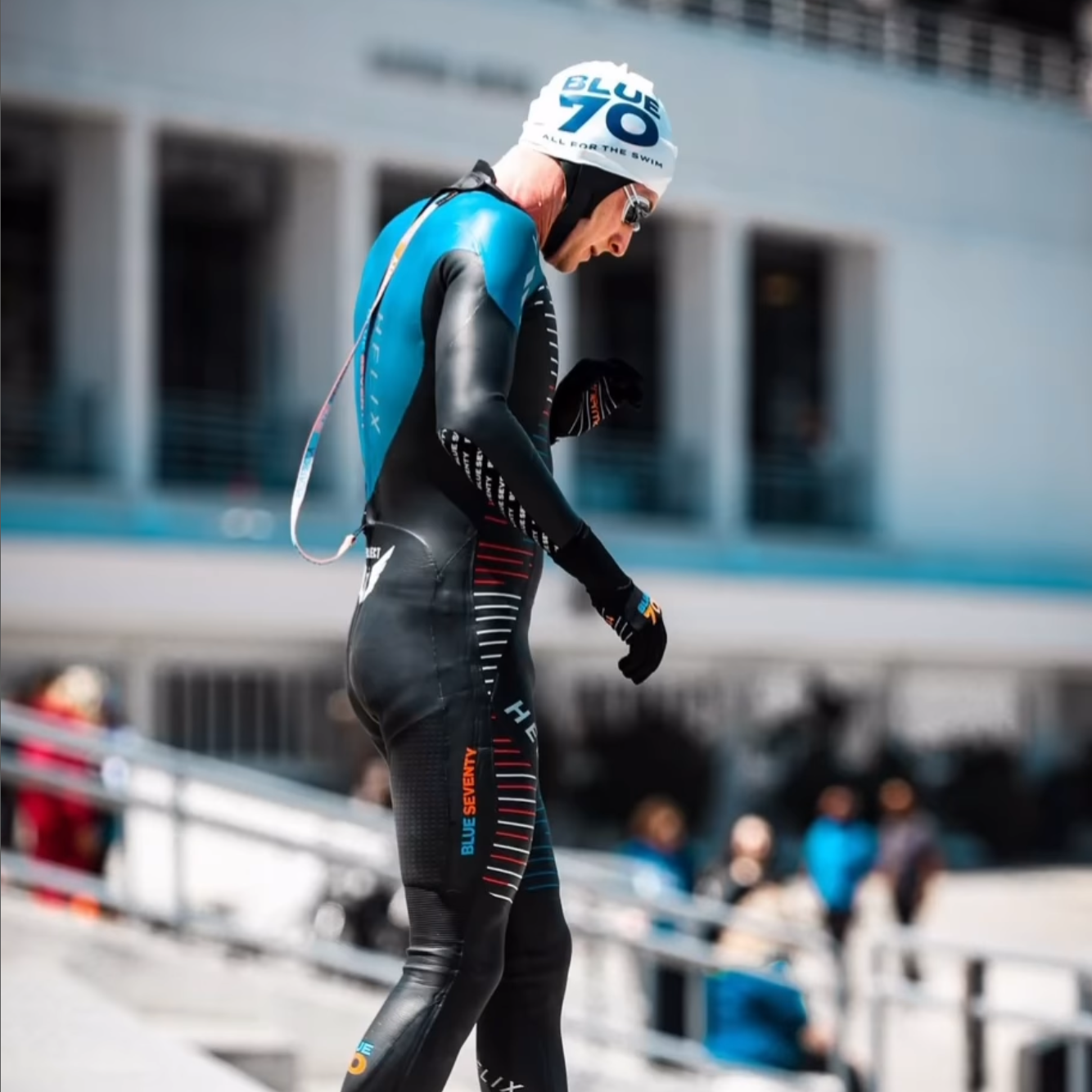
We've never pretended our race-day suits are the toughest thing in the closet - that's not really the point of them. Thinner, high-flex neoprene, like what you'll find through the shoulders and arms of the Helix, is more prone to compression set precisely because it's built to move so freely. That flexibility is what makes it fast in the water, but it also makes it a little less forgiving if it spends a winter creased the wrong way. Suits built for frequent training, like the Reaction or Fusion, use more robust neoprene and tend to handle imperfect storage a bit better. Still, no wetsuit - thin or thick - benefits from a hot attic, direct sunlight, or a wire hanger.
Your Wetsuit Is Aging Even When You're Not Swimming
Most swimmers think about wetsuit lifespan purely in terms of use - how many races, how many training sessions before it's time to shop for a new one. But a suit sitting improperly stored for five months every single year is still aging, even doing nothing. Treating the off-season as an actual part of wetsuit care, instead of an afterthought, is one of the easiest ways to protect what you've invested in and make sure the suit that felt great last September feels just as good the next time you're standing on a beach waiting for the horn.
Happy swimming - and happy storing.