


Ask any group of triathletes about race-morning water temperature and you'll hear the same question bouncing around transition: "Is it wetsuit legal?" There's a sigh of relief when the answer is yes, and mild panic when it's no. But that question, by itself, isn't really the one worth obsessing over.
Here's a better one: given today's actual water temperature and the distance you're about to swim, what's the smartest call for your body? That small shift in thinking turns a pass/fail rule check into a decision you actually have some control over - and it's the one we want to unpack here.
Start With the Rule - But Don't Stop There
Wetsuit-legal cutoffs come from sanctioning bodies like USA Triathlon, Ironman, and World Aquatics, and they're not identical to one another. They also change. Thresholds, mandatory-versus-optional zones, and age-group-versus-professional distinctions all get revisited over time, so last year's number isn't necessarily this year's number.
Which means this part is simple: check it, don't guess it. Race organizers post official wetsuit policy for each event, usually locked in during the final days before the start once actual water readings come in. Skip the forum threads and the "I think it was..." from a training partner. Pull the current rule from the athlete guide or the sanctioning body's current rulebook. Five minutes, zero ambiguity.
Once you've got that number, the more useful work starts - because being allowed to wear a wetsuit and knowing whether you should are two very different questions.
The Gap Between Legal and Optimal
Most wetsuit-temperature advice stops at the cutoff and calls it a day. But the legal window is often wide - stretching from genuinely cold water up to a temperature that's already uncomfortably warm for full neoprene, depending on how far you're swimming and how your body handles heat.
That gap is where the real decisions get made. And where they get made poorly, more often than you'd think.
The Warm End Catches a Lot of Swimmers Off Guard
Once water climbs above roughly 70-72°F, a full wetsuit starts working against you over anything beyond a short swim. Neoprene traps heat, and at that point, heat management - not buoyancy - becomes the thing limiting your swim. You can be completely wetsuit-legal at 74°F and still be making the wrong call by zipping into full sleeves for a 70.3 or full-distance swim.
This is exactly why sleeveless wetsuits and swimskins exist as their own category rather than a scaled-down version of a full suit. Sleeveless designs keep buoyancy through the torso and hips, where it does the most for your body position, while venting heat through the shoulders and arms - areas already generating plenty of warmth from the stroke itself. If you've ever stripped off a full wetsuit after a warm swim and felt like you just climbed out of a sauna, that wasn't your imagination. It's a real cost, and one you can manage just by matching coverage to conditions instead of defaulting to "full suit because it's legal."
Quick gut-check: if race-day water sits comfortably inside the legal window but on the warm side, ask yourself honestly whether you're chasing buoyancy or just habit. For longer distances especially, sleeveless is frequently the smarter tool - not the lesser one.
The Cold End Deserves More Respect Than It Usually Gets
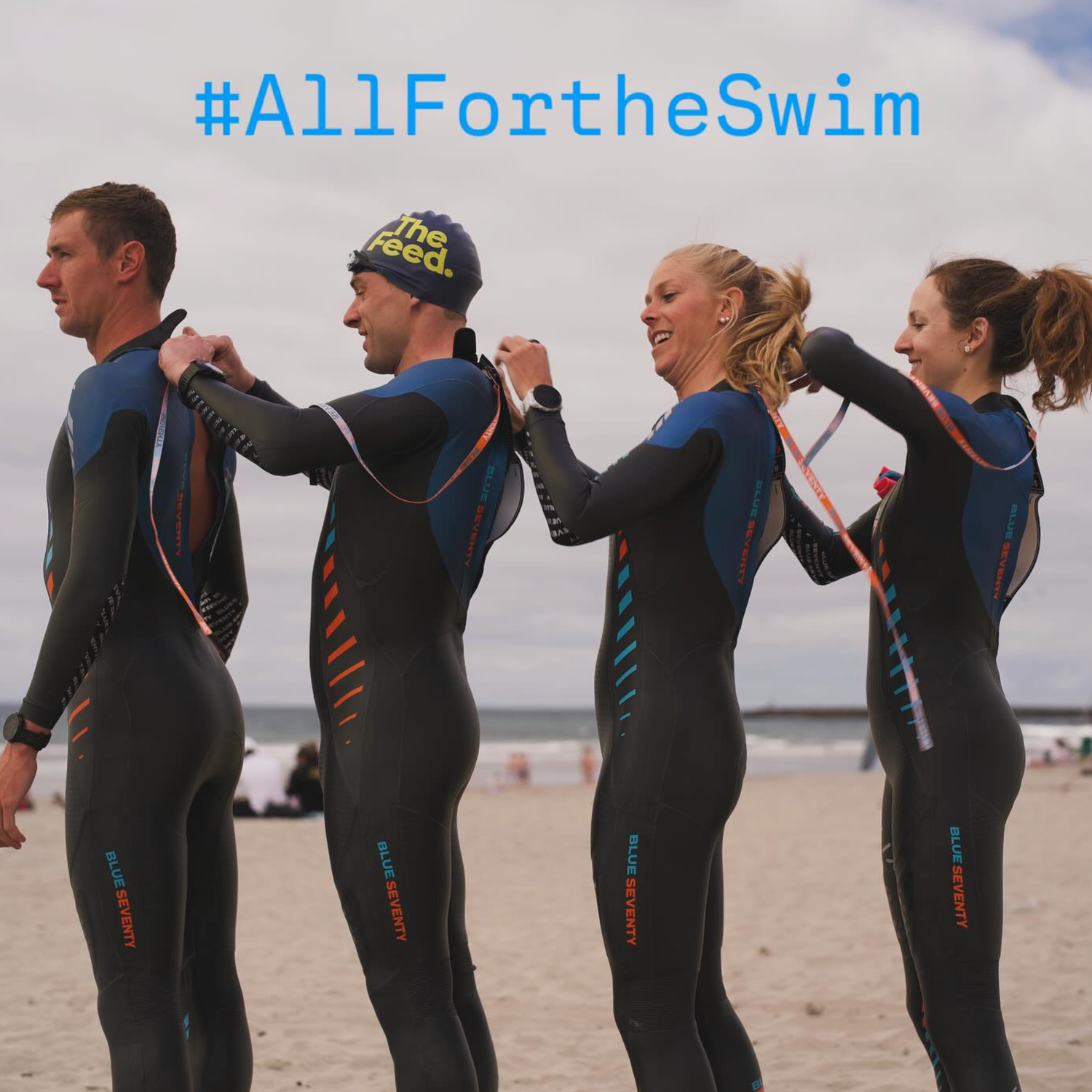
On the other side, athletes tend to treat "wetsuit legal" as shorthand for "handled." It isn't. Below roughly 56-58°F, a standard triathlon wetsuit - even a well-built one - isn't doing the same job as a suit designed specifically for cold water. This is where something like the Blue70 Thermal Reaction, fully lined with a Zirconium jersey interior, is providing meaningfully more thermal protection than a summer-weight race suit. That's not marketing language. It's the physical difference between an insulating layer against your skin and bare neoprene.
Cold water swimming asks real things of your body: quicker fatigue, an elevated heart rate response, and stroke mechanics that start to break down as your extremities cool. None of that means cold swims should be avoided - plenty of committed open-water swimmers train through genuinely cold water all season. It means the smart approach involves building exposure gradually, knowing your own cold tolerance honestly, and choosing gear for the water you'll actually be in - not just the coldest temperature the rulebook technically allows. If you're newer to cold water, ease into it over multiple sessions, and never let a wetsuit substitute for good judgment about how long you can safely stay in.
Same Rule, Same Water, Two Right Answers
Picture two athletes lining up for the same 70.3 swim start, water sitting at 71°F - comfortably inside the wetsuit-legal window.
The first is a strong, confident open-water swimmer racing to hold pace across the full 1.9k. For her, full neoprene at 71°F over that distance means fighting heat buildup by the final buoy - she's not gaining much from extra buoyancy she's already generating through solid body position, and she's paying a real thermal price for it.
The second is newer to the sport, still building open-water confidence, and leans on wetsuit buoyancy to hold a stable position and save energy. For him, that same water and the same full wetsuit might still be exactly right - the confidence and position benefit outweigh the heat cost, especially since less experienced swimmers tend to gain proportionally more from wetsuit buoyancy than seasoned swimmers already holding a strong line.
Same rule. Same water. Two different - and both correct - decisions. That's really the whole point: the legal window is a boundary, not an instruction manual.
A Practical Way to Approach Race Week
Instead of trying to memorize a single temperature chart, run through this instead:
- Confirm the official rule for your specific race. Pull it from the athlete guide or sanctioning body directly, as close to race morning as possible, since it's often finalized late.
- Weigh water temperature against your actual swim distance. A 70°F reading feels very different across a 750m sprint versus a 3.8k full-distance swim. Longer exposure at the same temperature nudges you toward less coverage, not more.
- Separate "legal" from "best for me." If you're wetsuit-legal but the water leans warm, consider whether sleeveless serves you better than full sleeves.
- If you're near the cold end, plan for it before race week. Train in a suit that matches expected conditions rather than finding out on the start line that your summer wetsuit isn't warm enough.
- Test it before you trust it. The only real way to know how a suit performs for you at a given temperature is to get in the water with it beforehand.
That last point matters more than people give it credit for. However carefully you size up conditions on paper, race morning isn't the time to discover your suit choice was wrong. It's exactly why we built our Test Swim policy the way we did - you can swim in a Blue70 wetsuit and still exchange or return it, as long as it comes back clean and dry.
Why Any of This Matters
It's worth remembering the core physics behind the whole conversation: buoyancy equals speed. A wetsuit lifts your hips and legs, improves body position, and helps reduce drag - genuinely useful, especially if you're still building experience in open water, since less experienced swimmers tend to see more benefit from that improved position than advanced swimmers already holding solid form.
But that benefit only shows up if you're not fighting your own gear. A swimmer overheating in the back half of a swim leg starts losing form. A swimmer who's genuinely cold loses stroke mechanics and confidence early. Matching your suit - full, sleeveless, or thermal - to the actual conditions, rather than just the legal minimum or maximum, is how the buoyancy advantage keeps working for you instead of against you.
The Bottom Line
Wetsuit rules tell you what's allowed. They don't tell you what's right for your body, your race distance, or the water you'll actually be swimming in. Check the official rule every single time - never assume it carries over from last season or the last race. Then make your equipment call based on the physiology of the day: manage heat above roughly 70-72°F, add insulation below roughly 56-58°F, and confirm your choice with an honest test swim whenever you're not sure.
Dive in prepared, not just legal.