


Ask a group of triathletes what they put on their neck before a race, and petroleum jelly will come up fast. The advice has been around for years: put some around the collar line, maybe a little at the wrists and ankles, and hope you get through the swim without a raw neck. It sounds practical. In many cases, it also misses the real source of the problem.
If you wear a swim-specific wetsuit, vaseline is not the best answer. The reason comes down to two things: material compatibility and fit. Chafing often starts because the suit is sitting in the wrong place on your body. Petroleum jelly then adds another issue by transferring onto the neoprene, where it can leave residue in the parts of the suit that flex and seal the most.
That is why the better question is not “what can I smear on my neck?” The better question is “why is my wetsuit rubbing in the first place, and what solves it without making the suit harder to care for?”
Why petroleum jelly became a race-day habit
The habit came from a real need. Open water swimmers and triathletes deal with repeated friction at the neck, jawline, underarms, wrists, ankles, and zipper base. Add salt water, repeated sighting, race nerves, and a rushed suit-up, and those contact points get irritated fast.
Years ago, many athletes reached for whatever was easy to find and easy to apply. Petroleum jelly was both. It formed a skin barrier, it was cheap, and it ended up becoming part of race culture. The problem is that old habits tend to stick long after gear design changes.
Modern swim-specific wetsuits are built with more flexible materials, more refined panel layouts, and more precise neck and shoulder patterns than the heavy, generic suits many swimmers started with. A routine that grew out of convenience does not always match the way performance wetsuits should be treated now.
Why vaseline and neoprene do not belong together
blueseventy wetsuits use Yamamoto neoprene in 38, 39, and 40 cell constructions. Those materials are chosen for stretch, buoyancy, and freedom from restriction in the water. They are made to move with your stroke, not fight it.
Petroleum jelly is petroleum-based, and that matters. If you put it on your skin around the collar or cuffs, some of it ends up on the wetsuit. Repeated exposure to petroleum-based products can shorten the life of rubber materials and leave buildup in high-movement areas. You may not notice anything after one swim. Over a season, the story changes.
This matters even more in a high-performance suit. Thin shoulder and arm panels are one reason a race suit can feel so natural in the water, but thin neoprene also asks for better care. blueseventy has always been direct about that trade-off. The Helix is built for race-day performance with very thin, flexible neoprene in the arms and shoulders, and that same construction is not ideal for heavy training use because delicate neoprene breaks down faster with repeated wear. Adding petroleum residue to that mix makes little sense.
Most chafing starts with fit, not skin
This is the point many swimmers skip. They feel rubbing at the neck and assume they need more lubrication. In reality, the collar often rubs because the wetsuit is sitting too low through the legs, hips, torso, or shoulders.
If the suit is not pulled high enough, tension travels upward. The neckline shifts, the collar moves with every breath, and your head turn starts dragging the same edge of neoprene across the same patch of skin. That is a fit problem before it is a skin problem.
A swim-specific wetsuit should feel snug on land and then settle more comfortably once you are in the water. If it feels loaded in the shoulders or active around the neck before the swim starts, fix the suit position first.
Signs the collar problem is really a fit problem
- The shoulders feel tired before you have swum more than a few strokes.
- The neckline presses harder when you look forward to sight.
- The suit feels low in the crotch or hips.
- You feel the upper back pulling into the collar.
- The same small spot gets rubbed every swim, even after using anti-chafe product.
Those clues point back to how the suit is sitting on your body.
Neckline design helps, but donning matters more
Pattern design can reduce friction. blueseventy’s 2021 Fusion redesign added a lower-sitting neckline for comfort without losing the watertight seal. That kind of update matters because a better neckline sits cleaner and moves less.
But even a well-designed collar cannot do much if the suit is still hanging low in the torso or shoulders. Donning technique matters more than most swimmers realize.
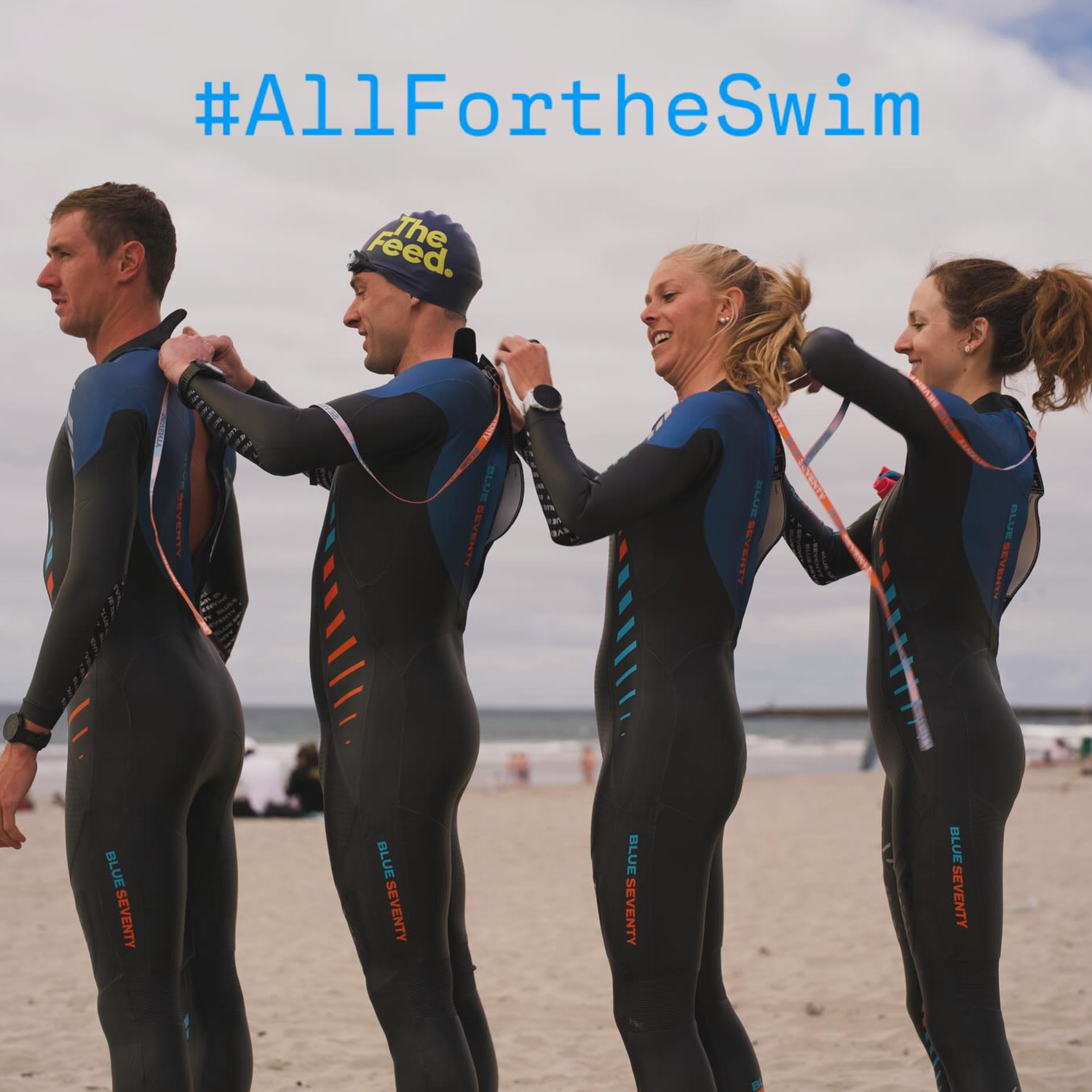
A better way to put on your wetsuit
- Pull the suit high through the calves first.
- Work it fully over the knees before you move higher.
- Bring all spare material up through the hips and glutes.
- Set the torso before you zip the back.
- Lift and settle the shoulder panels so your arms can move freely.
- Check that the collar lies flat before you head to the water.
Most swimmers who rush this process end up trying to fix a fit problem with a lubricant problem.
More lubrication can make things worse
It is easy to assume that if a small amount helps, a thick layer will help more. On race morning, that logic often backfires.
- A heavy layer transfers onto the collar.
- It can make the suit harder to handle while dressing.
- The collar may shift more instead of less.
- Sand and shoreline grit stick to it.
- Cleanup takes longer after the swim.
That sand problem is real. In a beach start, a greasy neck or cuff can pick up fine grit before you even get in the water. Once that grit sits between your skin and the wetsuit, the rubbing gets worse.
What to use instead
If you need an anti-chafe product, choose a non-petroleum formula that is safe for neoprene. Apply it to the skin, not to the wetsuit. Use only as much as you need to cover the friction point.
Common places to apply a neoprene-safe anti-chafe product
- Back of the neck
- Sides of the neck
- Along the jawline if you sight often
- Under the arms if your stroke creates rubbing there
- Around the ankle or wrist bones if those openings irritate your skin
Keep the layer light. The goal is to reduce friction on the skin while keeping the wetsuit itself as clean as possible.
The wrists-and-ankles myth
Some swimmers use petroleum jelly at the wrists and ankles because they think it will make the suit come off faster in T1. In practice, transition speed comes down more to technique than slipperiness.
A cleaner wetsuit exit usually depends on a few repeatable habits:
- Unzip early when race conditions allow it.
- Peel the suit to your waist while moving out of the water.
- Step out of the legs one side at a time without yanking.
- Practice removal before race day.
A good removal pattern saves more time than a greasy cuff.
Sunscreen can create the same issue
Petroleum jelly is not the only product that transfers onto a wetsuit collar. Sunscreen can do the same thing, especially around the neck, shoulders, and upper back.
You still need sun protection. The better move is to apply it carefully and avoid overloading the exact areas where the collar needs to sit cleanly against your skin. If the neckline has to grip and stay stable, too much product at that contact point can work against you.
A better race-day system
The best anti-chafe routine is simple. It starts before you put anything on your skin.
- Check your fit before race week, not on race morning.
- Put the suit on slowly enough to get the legs, hips, torso, and shoulders into place.
- Use a neoprene-safe anti-chafe product only where you need it.
- Warm up and notice any hot spots early.
- Rinse the wetsuit well after the swim to remove salt, sunscreen, and body product residue.
That system protects both comfort and the life of the suit.
Care habits matter more than most swimmers think
Wetsuit damage is not always dramatic. Yes, fingernail punctures and heel tears are common, and blueseventy’s warranty does not cover fingernail punctures, heel tears, or zipper damage caused by force. But small habits matter too. Residue buildup, repeated rubbing in the same spots, and rough handling all add up.
If you want your wetsuit to last, focus on the basics:
- Rinse it after every swim.
- Let it dry fully before storing it.
- Keep petroleum-based products off the neoprene.
- Trim your fingernails before putting it on.
- Do not force the zipper or yank the cuffs.
The practical answer
Can you use vaseline with a wetsuit? Yes. Many swimmers have done it for years. But if you want the better long-term answer, skip it.
Petroleum jelly is an old workaround for a problem that is usually better solved with fit, proper donning, and a neoprene-safe anti-chafe product. If your neck is getting chewed up every swim, do not assume you need more lubrication. Start by checking how the suit is sitting on your body. That is where most of the problem begins.
If you want help getting the fit right, start with blueseventy’s sizing tools, fit guidance, and Take a Test Swim program. A wetsuit that sits correctly in the water feels better, moves better, and gives you one less thing to think about when the swim starts.