


Swimmers who ask about sustainable wetsuits usually start with the material, asking whether the neoprene comes from limestone or petroleum, whether a foam is bio-based, or whether the lining has recycled content, but those questions miss the number that determines how much your wetsuit costs the environment.
That number is service life. A suit you pull on 300 times spreads its raw material, manufacturing energy, and shipping across three times as many swims as three suits you each use 100 times. The per-swim footprint drops by two-thirds. No hangtag will tell you that, but it is the foundation of any honest sustainability claim.
Service Life Is the Missing Metric
Every time you swim in the same wetsuit, its environmental cost per swim drops. The foam, the zipper, the lining, the factory energy, and the shipping fuel all stay fixed. The number of swims is the variable you control. A suit that sits in a closet unused is the worst outcome, regardless of what the foam was made from.
Durability belongs above material sourcing on the sustainability checklist. If your suit dies after one season, even the lowest-impact foam on the market has a poor per-swim footprint. If your suit survives four seasons, the material weight per swim becomes a smaller piece of the whole.
Why Materials Get the Headline
A new fiber or bio-based foam is easy to show in a marketing photo. Durability is not. You feel durability after two seasons, when the neck still seals, the ankles are not torn, and the shoulders still move. Most wetsuit failures begin at the seams, zipper, collar, ankles, and fingernail nicks. The material conversation should include construction and design, not chemistry alone.
The Neoprene Trade-Off in the Shoulders
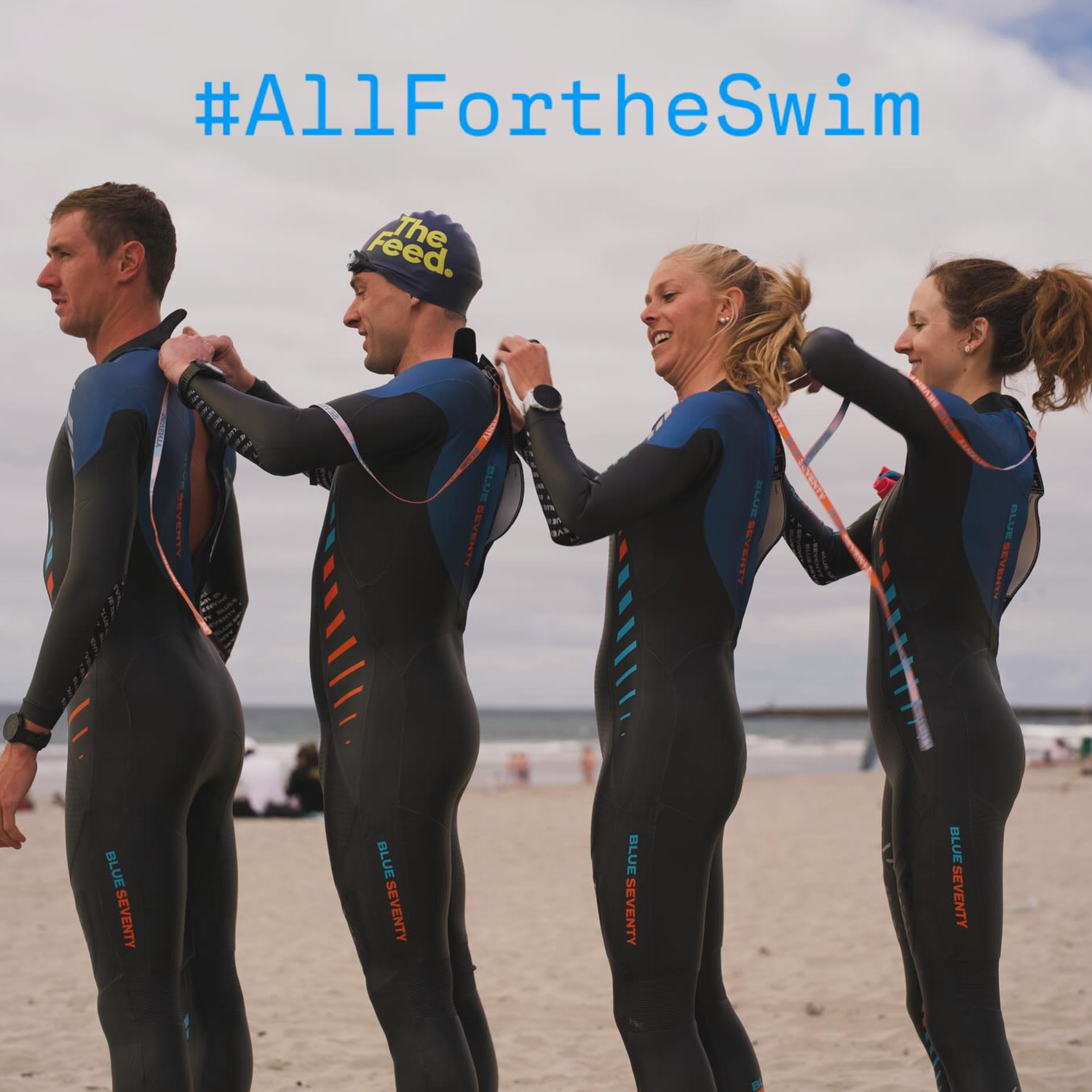
blueseventy wetsuits use neoprene in three cell grades: 38, 39, and 40. A higher cell number means more flexibility. That flexibility comes from thinner foam in the arms and shoulders of a race suit. The Helix is the clearest example. It is built for total race-day performance with thin, flexible neoprene in the arms and shoulders and a permeable catch panel. We say directly in our product guidance that it is not a heavy training suit. The thin neoprene will break down more quickly with frequent use.
That trade-off is real. If you swim once a week or more, the Reaction or Fusion gives you a longer service life. The decision comes down to how often you swim, not how fast you hope to race.
Matching the Suit to Your Training Week
We design the wetsuit line around training frequency. The Sprint at $325 is the entry-level suit. The Fusion at $420 is our best seller and the right pick for shorter frequent swims; its 2021 redesign lowered the neckline for comfort without losing the watertight seal. The Reaction at $680 uses higher-grade neoprene than the Fusion and is built for frequent, longer swims. The Helix at $995 is the race-day suit.
A Fusion used for shorter weekly swims will outlast a Helix used the same way. Both are honest designs for different jobs. The sustainable choice is the one you will use enough to justify the materials.
Repair, Fit, and Hidden Waste
Fingernail punctures, heel tears, and zipper damage from force are wear and tear, not manufacturing defects. You can repair or avoid all three. A small fingernail nick at the collar should be sealed with neoprene cement before it grows into a tear. Heat and chlorine degrade neoprene over time. Rinse the suit after every swim and dry it flat out of direct sun.
We cover manufacturing and material defects for one year from the original purchase. A well-maintained suit can outlast that window by several seasons. Your care routine is the bigger factor.
When a suit does not fit, you return it, we reship it, or it sits in a gear closet. That is waste before the first open-water stroke. The Test Swim policy removes much of that risk. You can swim in a wetsuit and still return or exchange it if it comes back clean, dry, unmodified, with tags and accessories attached.
A suit that fits properly also gets damaged less. Shoulders that are too tight force you to fight the suit, which leads to fingernail nicks and seam stress. A suit should feel snug on dry land and more comfortable in the water. That kind of fit lasts longer because you do not have to wrestle it.
Four Questions for Any Eco Claim
When a suit or component is marketed as sustainable, ask these four questions:
- What is the feedstock: petroleum, limestone, recycled content, or bio-based?
- What is the service life under real swimming conditions, not a lab flex test?
- Can the seams and zipper be repaired?
- What happens at end of life?
A limestone feedstock changes the starting point, not the entire production process. A recycled lining still has to survive repeated donning and salt water. These questions do not require a chemistry degree. They require a brand willing to publish the answers. If the answers are absent, the green label carries more weight than the material.
What a New Material Must Prove
Alternative wetsuit materials still have to earn their place. A foam that breaks down in a compost test but fails after 40 open-water swims is not a good trade for an athlete. The standard is straightforward. A new material needs to match the flexibility and insulation of current neoprene, survive several seasons, and be repairable. Until that exists, the most grounded sustainable choice is to buy the suit that matches your training frequency, care for it, and repair it.
A wetsuit is a piece of sporting equipment, not a disposable accessory. Buy for service life, rinse after every swim, repair small nicks with neoprene cement, and take the Test Swim before you commit to a size. If you are not sure which model matches your training week, use the sizing tool on our homepage. Happy swimming. All for the swim.