


A week before most triathlons, athletes start checking one number obsessively: will the water be wetsuit legal? It's a fair question. It just doesn't answer much. Wetsuit-legal temperature cutoffs vary by sanctioning body and shift from season to season, so check current rules through USAT, Ironman, or your specific race organizer before you plan around any number you saw last year. That rule tells you what's permitted for the whole field. It says nothing about what your body will do when you wade in at 6:45 AM.
Here's the better question: where does your personal comfort threshold sit, and how far below the legal cutoff can you swim before that threshold starts working against you? That gap between "legal" and "comfortable" is where most race-morning nerves actually live. And unlike the rulebook, that gap is something you can train for.
The First 90 Seconds Are the Hard Part
Cold water immersion sets off a well-studied physiological chain reaction before you've even taken a stroke. Researchers who study cold water response, including work out of the University of Portsmouth's Extreme Environments Laboratory, describe an involuntary gasp reflex on entry, followed by a spike in heart rate and a period of rapid breathing that usually peaks within the first minute or so and settles shortly after.
That timing matters more than most swimmers realize. The riskiest window in any cold swim isn't the middle of the leg. It's the start. Dive straight into a mass start with zero prior water contact, and you're asking your heart to handle race adrenaline and cold shock at the same moment. A brief pre-race dip, where the schedule allows one, takes the edge off that spike before the horn goes off.
The Cutoff Is a Population Average. You're a Sample of One.
Sanctioning bodies pick a single temperature threshold because they need one rule for a field of a thousand-plus swimmers with different builds, histories, and cold tolerance. That's reasonable for fairness. It's a lousy predictor of how you specifically will feel.
Body composition plays a real role. Subcutaneous fat distribution affects how fast core temperature drops during immersion, and it varies a lot between two athletes with similar fitness. So does recent cold exposure. A swimmer who spent the winter in a heated pool and hits open water for the first time that season will have a rougher morning than one who's been doing weekly lake swims since March, even under the identical legal rule.
Sleep. Hydration. Nerves. None of that shows up on a temperature chart. All of it shows up 400 meters into your swim.
What a Wetsuit Actually Does
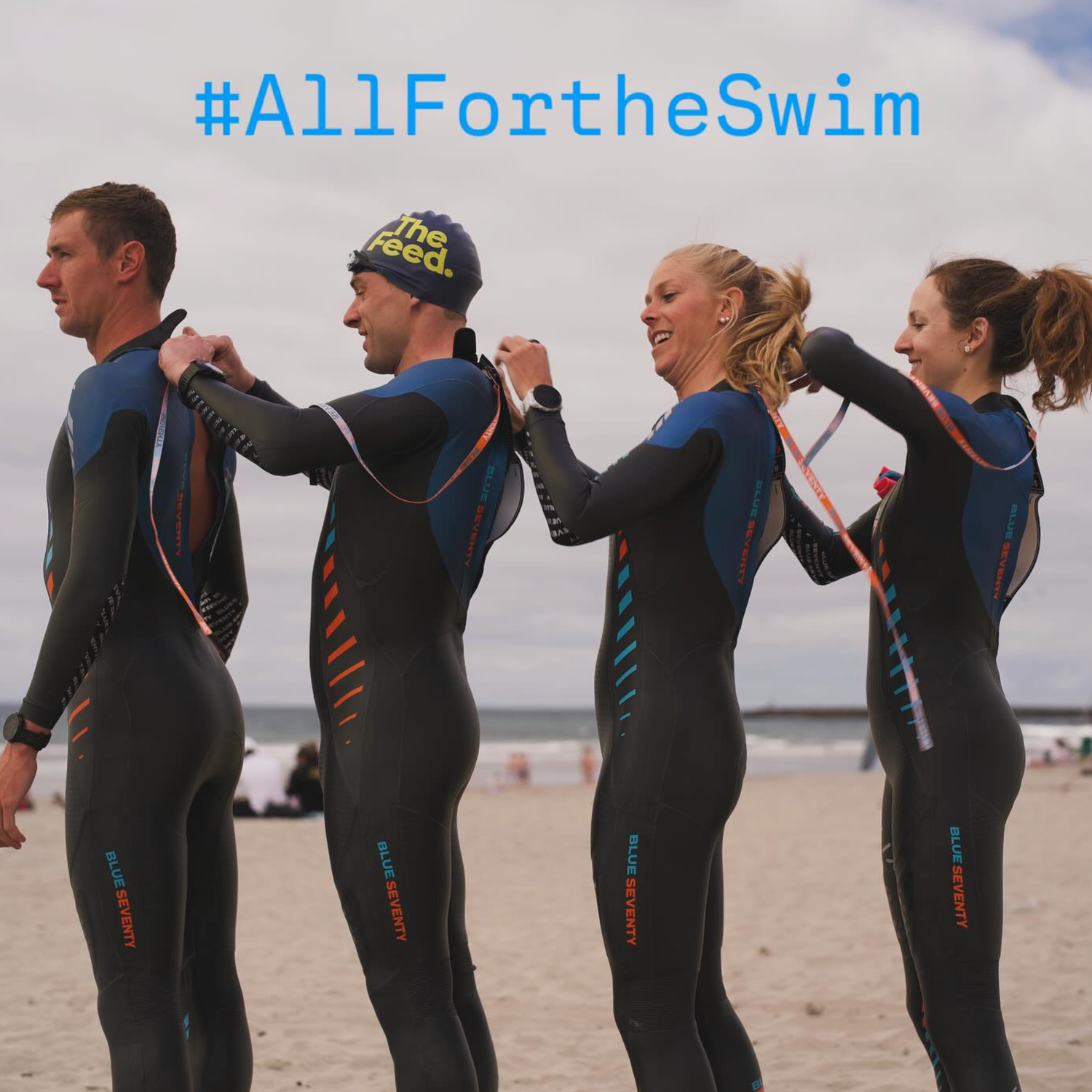
Neoprene doesn't generate heat. A wetsuit works by letting a thin layer of water in against your skin, which your body then warms. The suit's job is slowing how fast that warmed layer escapes. That's why fit matters as much as the material itself. A suit that's loose at the neck, wrists, or ankles flushes constantly, and flushing undoes most of whatever thermal benefit the neoprene was built to provide. A wetsuit adds thermal protection. It doesn't promise warmth no matter the conditions or how long you're in the water.
This is also why one suit doesn't fit every temperature range. Blue70's Thermal Reaction is fully lined with Zirconium jersey, a synthetic wool built specifically to hold warmth in cold water, and it exists because plenty of swimmers train and race well below where a standard race suit still feels good. As a general guide, once water drops below roughly 56 to 58°F, a purpose-built thermal suit starts to make a real, felt difference. Above roughly 70 to 72°F, the opposite problem shows up: a full suit can hold in more heat than a long swim calls for, which is where sleeveless designs earn their keep.
Neither suit is better in the abstract. The right one just depends on your water.
Distance Changes the Equation
Temperature cutoffs get set as a single number. But your actual thermal load is temperature multiplied by time. A sprint swim at 60°F and a full-distance swim at that same 60°F are not the same event for your body, even though both are covered by one identical rule.
If you're training for a 70.3 or full-distance race in cool water, you're carrying that thermal load for 60 to 90-plus minutes, not 15. That's exactly why a suit built for sustained cold behaves differently than one built for a shorter warm-water swim, even when both are technically legal for your race. Distance deserves a seat at the table when you're picking cold-water gear, not just the posted forecast.
Acclimatization Is Trainable
Cold tolerance isn't fixed. Repeated, gradual cold exposure produces a measurable acclimatization effect: swimmers who get in cold water consistently show a smaller cold shock response and settle their breathing faster than they did on their first cold swim of the season.
The practical move here is simple. If your target race sits in colder water than wherever you usually train, don't wait until race week to find out how you'll handle it. Build short open-water sessions into your training block weeks out, at or near your expected race temperature. Ten to fifteen minutes, done consistently, does more for your personal threshold than one miserable hour-long swim the weekend before.
A Race-Morning Checklist Worth More Than the Forecast
- Get in the water before the start if you can, even for a minute. Absorbing the cold shock before the gun goes off beats absorbing it during the swim.
- Count how many strokes it takes your breathing to settle in training swims. Track that number across the season; it tells you more than any water temperature app.
- Check whether your hands still feel normal halfway through a training swim in similar conditions. Losing fine motor control early is a signal worth paying attention to.
- Match your suit choice to your race distance, not just its legality. A suit that's fine for a sprint might not be the right call for a half or full-distance swim in the same water.
- Make sure your suit sits snug at the neck, wrists, and ankles. A suit that flushes constantly gives up most of its thermal value no matter what the neoprene is rated for.
The Bottom Line
Check the official rule for your race so you know what's allowed. Then set that number aside for the planning that actually matters: your acclimatization history, your race distance, and whether the suit you're wearing was built for the water you'll actually be in. The legal cutoff protects the field. Your preparation protects your race.
If you're not sure whether your current suit matches the conditions you'll be training and racing in this season, Blue70's size and fit guidance can help you sort that out before you're standing on a beach finding out the hard way. And if you want to test a suit in real water before you commit, Blue70's Test Swim policy lets you do exactly that: swim in it first, and as long as it comes back clean, dry, and tagged, you can still exchange it within 30 days.