


Triathletes will happily spend weeks thinking about wetsuit fit, buoyancy, shoulder flexibility, and open-water confidence. Then race morning arrives, and one of the most useful tools in the entire swim-to-bike handoff gets treated like an afterthought: the transition mat.
That is a mistake.
A transition mat is not just a clean place to stand while you pull on your helmet. It affects how you remove your wetsuit, how quickly you recognize your space, how organized your gear stays, and how calm you feel during one of the most rushed moments of the day. If your goal is smoother race execution, the mat deserves a place in the conversation right alongside your wetsuit.
The bigger point is this: T1 is still part of your swim performance. Your wetsuit has done its job in the water, but the race value of that suit is not fully realized until you are out of it cleanly and moving toward the bike without wasting time or energy.
T1 is not dead time
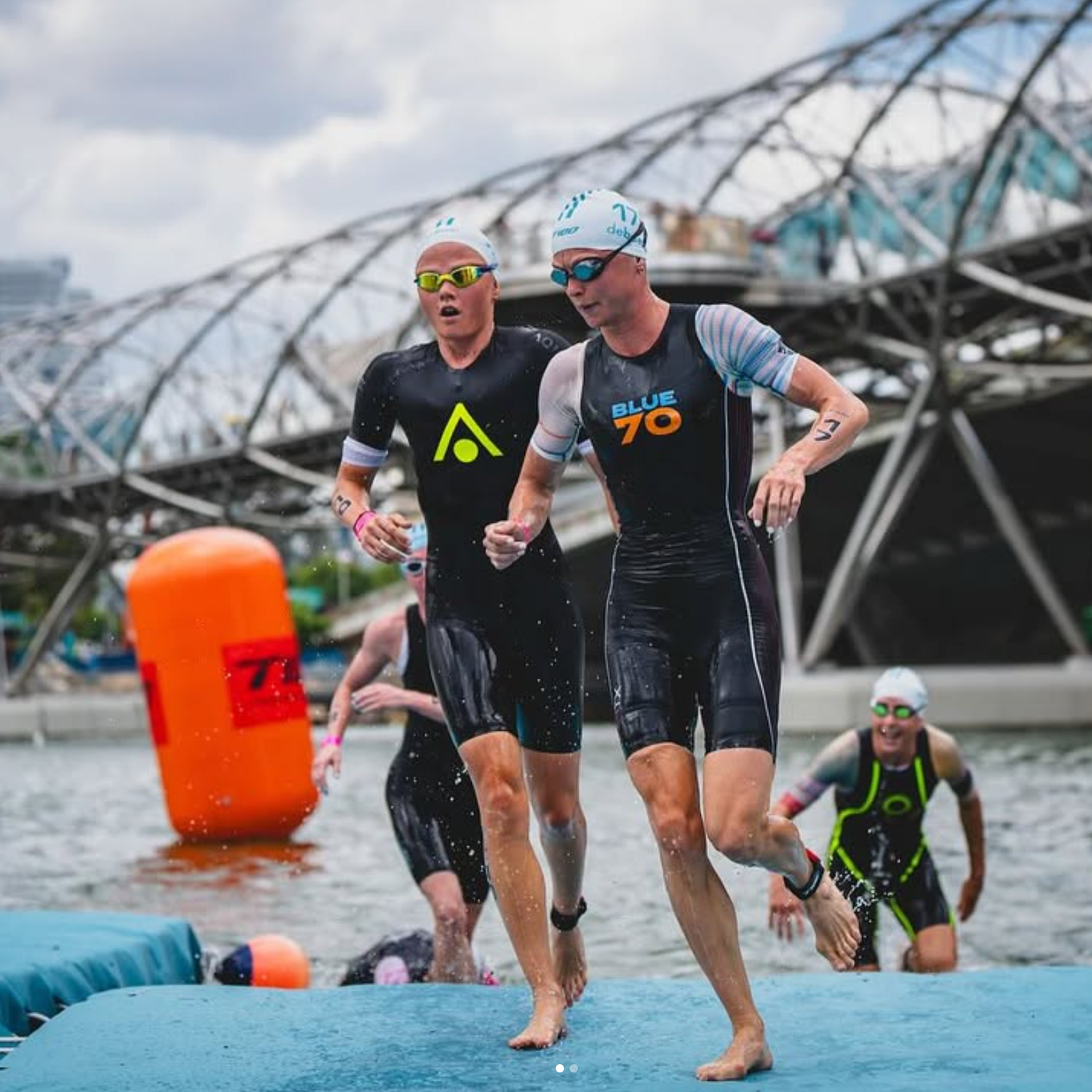
Many athletes think of transition as a gap between disciplines. In reality, it is a skills test. You are coming out of the water with your heart rate elevated, your breathing still high, your feet wet, and sometimes your hands cold or clumsy. You have to go from horizontal swimming to upright running, then quickly shift into the mechanical routine of cycling.
That is a lot to ask of your body in a short space of time.
A transition mat helps because it reduces friction in that process. Not hydrodynamic friction. Execution friction. It gives you a defined space to stop, a more predictable surface underfoot, and a cleaner area for your wetsuit and race gear.
That may sound minor when you are packing the car the day before a race. It feels much less minor when you are trying to step out of neoprene with wet feet and a rack full of bikes around you.
The real value is not comfort
Most people think a transition mat is about comfort. It keeps your feet off gravel, hot pavement, or damp grass. That is useful, but it is not the best reason to use one.
The real benefit is sequencing.
Good transitions are rarely frantic. The athletes who move best through T1 usually are not the ones making the biggest gestures or rushing every motion. They are the ones who arrive at their spot, know exactly where everything is, strip the wetsuit without hesitation, and move to the next task in order.
A mat helps make that possible because it turns your little patch of transition into a repeatable workstation. It tells your body where to stop and your eyes where to look. In a busy transition area, that clarity matters more than athletes often realize.
Why wetsuit removal gets messy
A swim-specific wetsuit should feel snug on land and more comfortable in the water. That close fit is a big part of what helps body position and supports strong swimming mechanics. But the same snug fit can work against you in T1 if you have not practiced getting out of the suit properly.
Stepping out of a wetsuit is not hard, but it is technical enough that poor timing creates chaos. You are balancing on one foot, peeling neoprene over the ankle, and trying not to lose your footing or kick your gear across the mat.
That is why so many athletes waste time with the dramatic hop-and-stomp approach. They are trying to create speed by forcing the motion. Usually, they create the opposite.
A cleaner way to step out of your wetsuit
Instead of trying to kick free as fast as possible, use a more controlled sequence:
- Pull the wetsuit down past the hips first.
- Keep peeling until the suit is around mid-calf.
- Plant one foot firmly on the mat.
- Use your hands to free the opposite heel and ankle.
- Step out one leg at a time.
- Keep the movement compact rather than explosive.
That approach is usually faster in real race conditions because it reduces the little mistakes that add up: slipping, overbalancing, re-grabbing the suit, or stepping on the neoprene awkwardly.
The surface under your feet matters
This is where the transition mat becomes more than just organizational gear.
Coming out of open water can leave you feeling slightly off-balance, especially if the swim was hard, the exit is uneven, or the water is cold. That is normal. But it means the quality of the surface under your feet matters at exactly the moment you are trying to do something precise.
A stable mat gives you a better platform for single-leg balance while removing the lower half of your wetsuit. It also gives your feet a predictable texture and location in a transition area that may otherwise be slick, rough, sandy, muddy, or cluttered.
That extra bit of control often leads to a calmer T1, and calm almost always looks faster.
A transition mat can help you treat your wetsuit better
There is another advantage here that athletes often miss: a mat can help reduce unnecessary abuse to your wetsuit during removal.
blueseventy wetsuits are swim-specific, designed and tested for performance in the water. Depending on the model, that may mean more flexibility through the shoulders, buoyancy placement to improve body position, or added thermal protection for colder swims. Whatever suit you race in, handling matters.
Dropping neoprene onto rough pavement, twisting the ankles aggressively against gritty ground, or stepping on the suit while trying to yank it free can all create avoidable wear over time.
A mat does not make a wetsuit indestructible, and it does not replace careful technique. Common damage still usually comes from things like:
- pulling with fingernails while putting the suit on
- forcing the zipper
- creating heel tears during rushed removal
- stepping on the suit with grit underfoot
- dragging neoprene across abrasive ground
But a mat gives you a cleaner, more controlled surface for one of the highest-friction moments of the race.
The visual anchor effect
In a crowded transition zone, a mat also works as a visual anchor. That matters more than it sounds like it should.
After the swim, athletes are often scanning rows of bikes while trying to lower their breathing and start their routine. Even when you know where your rack is, it can take a moment to pick out your exact spot. A mat that is easy to recognize at a glance helps shorten that search.
The advantage is simple: less hesitation, less second-guessing, and less time standing still while your brain catches up.
What to look for in a triathlon transition mat
You do not need anything elaborate. A simple mat often works best. Look for a few practical qualities:
- Compact size so it fits your transition space without creating clutter
- Enough grip that it stays put when wet
- Thin, packable construction that is easy to bring to races
- Easy cleanup after sand, grass, mud, and road grime
- Good visibility so you can identify your setup quickly
The right mat is not the one with the most features. It is the one that supports your routine without adding another thing to manage.
Set it up like a workstation, not a beach towel
The mat only helps if your layout makes sense.
Keep the front of the mat clear enough to step out of your wetsuit. Place your helmet where you can grab it immediately. Put sunglasses and other essentials in the order you will use them. Avoid turning your transition space into a pile of “just in case” items.
Simple setups are faster to read and easier to repeat.
A practical T1 setup
- Lay the mat square to your rack position.
- Use the front portion for wetsuit removal.
- Keep your helmet accessible and ready to go on immediately after the suit is off.
- Place smaller items in the exact order your hands will use them.
- Keep unnecessary extras out of the way.
The best benefit comes from practice
This is the part that matters most: the transition mat is helpful, but practice is what turns it into a real race-day advantage.
If you have never rehearsed your wetsuit removal and T1 setup, the mat will not magically solve that. What it does do is support a sequence you have already made familiar.
Before your next race, practice the full flow:
- Put your wetsuit on correctly, especially through the shoulders.
- If possible, get the suit wet so removal feels realistic.
- Rehearse unzipping and peeling the top half down.
- Step onto your mat and practice removing the legs smoothly.
- Move through the exact order of helmet, glasses, and bike exit.
Do that a few times, and race morning feels far less chaotic.
Why beginners benefit the most
First-time triathletes usually focus on the obvious worries: the open-water start, the cold, the crowd, the fit of the wetsuit, the fear of swimming off line. Those are real concerns. But many beginners are surprised to find that transition feels more stressful than the swim itself.
That is because transition demands quick decisions at a moment when your body is not fully settled yet.
A mat helps make T1 more readable. It gives you a clear place to stop, a clear surface to stand on, and a better chance of following the routine you practiced. For beginners, that structure can make a big difference in confidence.
The takeaway
A transition mat looks like a small detail because it is a small object. But triathlon rewards details that improve execution, and this is one of them.
Think of your transition mat as part of your wetsuit strategy, not separate from it. It helps you finish the swim well by supporting steadier footing, cleaner wetsuit removal, better gear organization, and a calmer T1.
That is not flashy. It is just good race craft.
If you are dialing in your full race-day setup, start with fit. A wetsuit that is properly sized and properly donned is much easier to remove cleanly in transition. You can learn more in the fit guide or Take a Test Swim to rehearse your race-day routine with confidence.