


I still remember the first time I held a pointzero3 in 2006. It weighed almost nothing. It looked like someone had taken a wetsuit and boiled away all the rubber, leaving behind a slippery, impossibly thin second skin. The triathlon world was used to neoprene - thick, buoyant, warm. This suit was none of those things. And later that year, both the men’s and women’s champions at the Ironman World Championship crossed the line wearing one. Not despite the lack of flotation. Because of it.
A lot of people still walk into a shop, pick up a modern swimskin, and ask: “So this is basically a wetsuit for warm water, right?” It’s an understandable shortcut, but it misses the whole point. A swimskin wasn’t designed to replace a wetsuit. It was built to answer a question no one was asking loudly enough yet: what happens when the water is too hot for neoprene, but you still want every possible second shaved off your swim?
The answer turned out to be a complete rethink of how speed happens in the water. Wetsuits make you faster by lifting your hips and legs into a streamlined position - buoyancy equals speed, as we like to say. But the swimskin’s magic is entirely different. It’s neutrally buoyant on purpose. It gives up that passive lift and instead works on three other fronts: surface drag, form drag, and feel.
The physics of a suit that refuses to lift you
To understand a swimskin, you have to look at the forces acting on a swimmer’s body at race pace. Frictional resistance - the drag caused by water clinging to your skin or suit - climbs dramatically with speed. A high-quality swimskin fabric is treated with hydrophobic coatings that repel water, creating a layer that slips past the surrounding water more cleanly than bare skin ever could. That alone can be worth real seconds over distance.
Then there’s form drag. Your body isn’t a smooth torpedo; it’s full of subtle contours, pockets, and pressure points. A well-cut swimskin compresses gently, holding your frame in a consistently streamlined shape. It’s not about squeezing you into a smaller size - it’s about eliminating the small eddies and pressure drag that a naked torso can’t avoid. Think of it as a constant, quiet reminder to stay long, tight, and hydrodynamically boring.
And finally, there’s what we call feel for the water. This is the one that hooks lifelong swimmers. A wetsuit, even a phenomenally flexible one like the Helix, changes your stroke slightly. There’s material over the shoulders, there’s buoyancy pushing your body up, and your proprioception shifts. A swimskin gives you none of that. Your hand entry, your catch, your high elbow recovery - they feel exactly like they do during a Tuesday morning pool session. For an athlete who has drilled that stroke into muscle memory for years, that familiarity can unlock a calmer, more efficient swim when the gun goes off.
The short-sleeve gamble that paid off
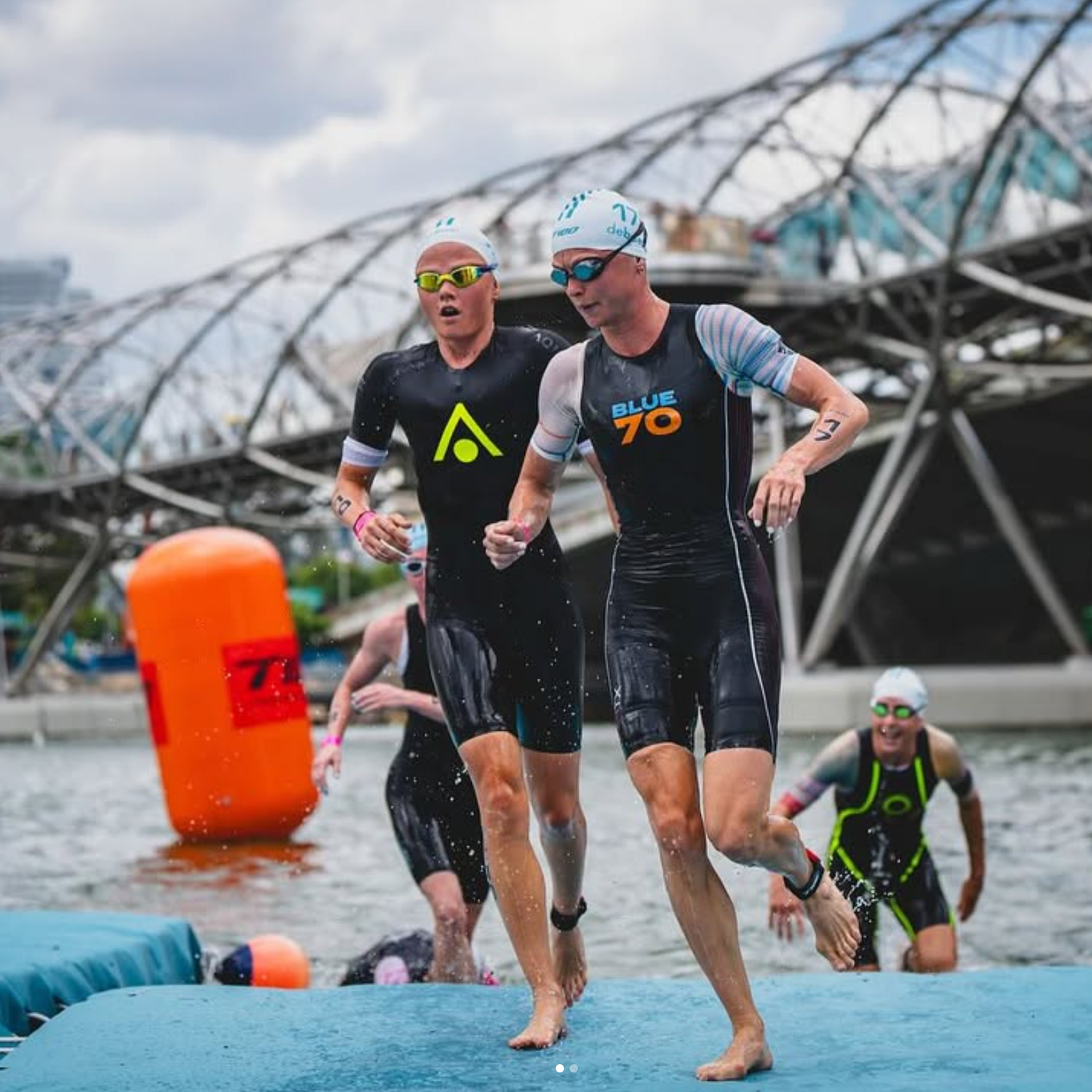
In 2016, blueseventy did something that raised eyebrows: we put short sleeves on a swimskin. At first glance, it looked like a compromise nobody asked for. But those sleeves cover the upper arm and shoulder with the same drag-reducing fabric, cutting frictional resistance across the very surfaces that slice through the water on every stroke. Meanwhile, your elbow and forearm are completely free, so the high recovery motion - the one that makes an efficient stroke efficient - remains unrestricted. Full wetsuit sleeves inevitably limit that motion to some degree; a sleeveless swimskin leaves your arms naked. The short-sleeve swimskin splits the difference, and for warm-water 70.3 and full-distance racers, it’s been a quiet revelation.
The hybrid approach no one talked about ten years ago
There’s another piece of gear that’s subtly changing how athletes think about warm-water racing: the buoyancy short. Our LIFT short was the first to use closed-cell NBR foam, and it delivers targeted lift right where you want it - hips and thighs - without wrapping your chest or shoulders. In a race where the water is borderline wetsuit-legal but you know a full suit will cook you by the halfway mark, pairing LIFT shorts with a swimskin gives you back a little of that position assistance while keeping your arms completely free. It’s not a combination that works for everyone, but if you’re a swimmer who tends to sink at the hips and overheat at the core, it’s worth experimenting with in training.
When to choose which: a decision framework, not a rule
Water temperature is where you start, but it’s not where you end. Here’s how I think about it with the athletes I talk to.
- Below roughly 56-58°F (13-14°C): This is thermal territory. A purpose-built cold-water suit like our Thermal Reaction is almost always the right call. Insulation and buoyancy matter more than anything else at these temperatures.
- Between about 58°F and 65°F (14-18°C): A performance wetsuit - the Reaction for frequent long swims, the Fusion for shorter training sessions, or the Helix for pure race-day speed - gives the buoyancy advantage most swimmers ride to a faster split. The warmth and lift usually outweigh any shoulder restriction.
- Between about 65°F and 72°F (18-22°C): This is where the decision gets personal. If you’re a confident swimmer with a naturally horizontal body position and you overheat easily, a swimskin can feel faster because you aren’t fighting the neoprene’s warmth or resistance. If you’re newer to open water or tire without the extra lift, a sleeveless wetsuit still tends to win. Test both well before race morning.
- Above about 72°F (22°C): The swimskin becomes the default for most racers. Overheating in a full wetsuit is no joke, and the drag reduction of a fast swimskin easily outweighs the diminishing returns of buoyancy at this point.
Race distance plays a role, too. A sprint with a 750 m swim might tilt toward a swimskin purely for the seconds saved in T1 - no zipper to tug, no neoprene to peel off. For a full Ironman’s 3.8 km swim, buoyancy tends to win the argument because energy conservation is everything - unless the heat tips the scales the other way.
Keeping a swimskin fast for more than one season
Swimskins are made from delicate, highly engineered fabrics, and they ask for a little patience in return. The two most common ways I see these suits get damaged are fingernail punctures and rushed donning. Never pinch a tiny area of fabric and yank; use the pads of your fingers and work the suit up slowly, inch by inch.
Rinse it in fresh water after every swim - chlorine and salt both degrade the hydrophobic coating over time - and let it dry flat, out of direct sunlight. Don’t roll it into a tight ball for storage like you might with a neoprene wetsuit; loosely fold it or hang it on a wide, padded hanger. Treat it this way, and a blueseventy swimskin will hold its race-day performance across multiple seasons. Reserve it for key tune-up swims and events, not daily training.
A suit that gets out of your way
The swimskin isn’t a downgrade from a wetsuit. It’s a different tool for a different day. It strips away heat, bulk, and artificial lift so a good swimmer can have their best swim - no adaptation period, no gear fighting the stroke. That philosophy has been part of blueseventy’s DNA since the pointzero3 first hit the water at Kona, and it’s why every swimskin we make is cut with the same intention: disappear on your body and let you move like you.
And for women, that means the same Femme Fit that runs through all our suits - adjusted patterns through the bust, torso, and hips - so the suit stays where it belongs and feels like an extension of your own skin instead of a garment pulling in the wrong places.
Curious about our current swimskin designs? They’re the direct descendants of that first radical suit in 2006, refined year after year with feedback from athletes who demand a suit that feels like nothing, and a swim that feels like everything.