


Most explanations of wetsuit speed stop at one idea. Neoprene floats. Floating improves body position. Better position means less drag. That's true, but it treats wetsuit benefit like a fixed number, as if a suit adds the same few seconds per hundred meters at minute two as it does at minute forty. It doesn't work that way. The advantage changes shape over the course of a swim, and knowing why can change how you pace a race and how you think about your own suit.
Two different jobs, not one
A wetsuit does two separate things in the water. They don't behave the same way over distance, and it's worth pulling them apart.
The first is surface drag reduction. Neoprene moves through water differently than bare skin or thin swimsuit fabric. A smoother surface meets less resistance. This effect shows up from your first stroke off the beach and stays roughly constant whether you're 200 meters in or 2,000.
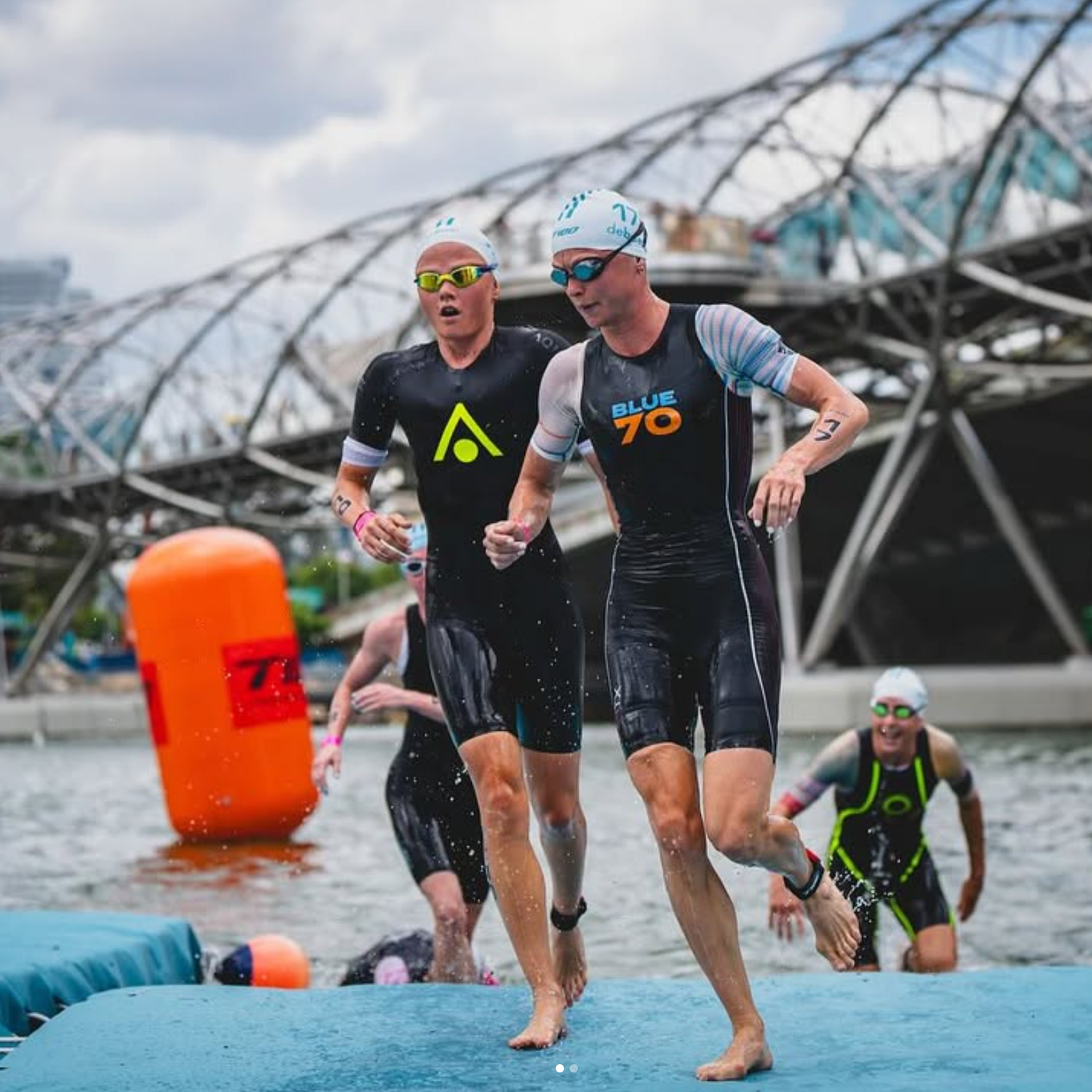
The second is body position, driven by buoyancy. Panels built into the hips and legs lift the lower body toward the surface, shortening the angle between shoulders and feet and cutting the frontal area you're dragging through the water. This is the mechanism behind Blue70's LIFT buoyancy panels, introduced on the Helix in 2018. Position correction isn't steady like surface drag. It matters more, not less, as a swim goes on, because body position is exactly what falls apart as you tire.
What the research found
Dutch physiologist Huub Toussaint and colleagues at the Vrije Universiteit Amsterdam began measuring wetsuit drag effects in the late 1980s, using systems that measure active drag directly instead of estimating it. Their work showed that neoprene lowers the resistance a swimmer has to overcome at a given speed, and that the effect comes mostly from the position change described above, not from surface slickness alone. A swimmer holding the same pace in a wetsuit is doing less work to hold it.
A 2003 review by Chatard and Wilson in Medicine & Science in Sports & Exercise looked across this research and landed on a conclusion worth sitting with: wetsuits help less proficient swimmers more than they help elite swimmers. A swimmer with weaker body position to start has more room for a suit to correct. An elite swimmer already holds a flat, efficient line, so there's less to gain. Blue70 tells its own customers something similar in plain terms: beginners typically see a bigger benefit than advanced racers, because there's more position error available to fix.
Why the back half is where this shows up
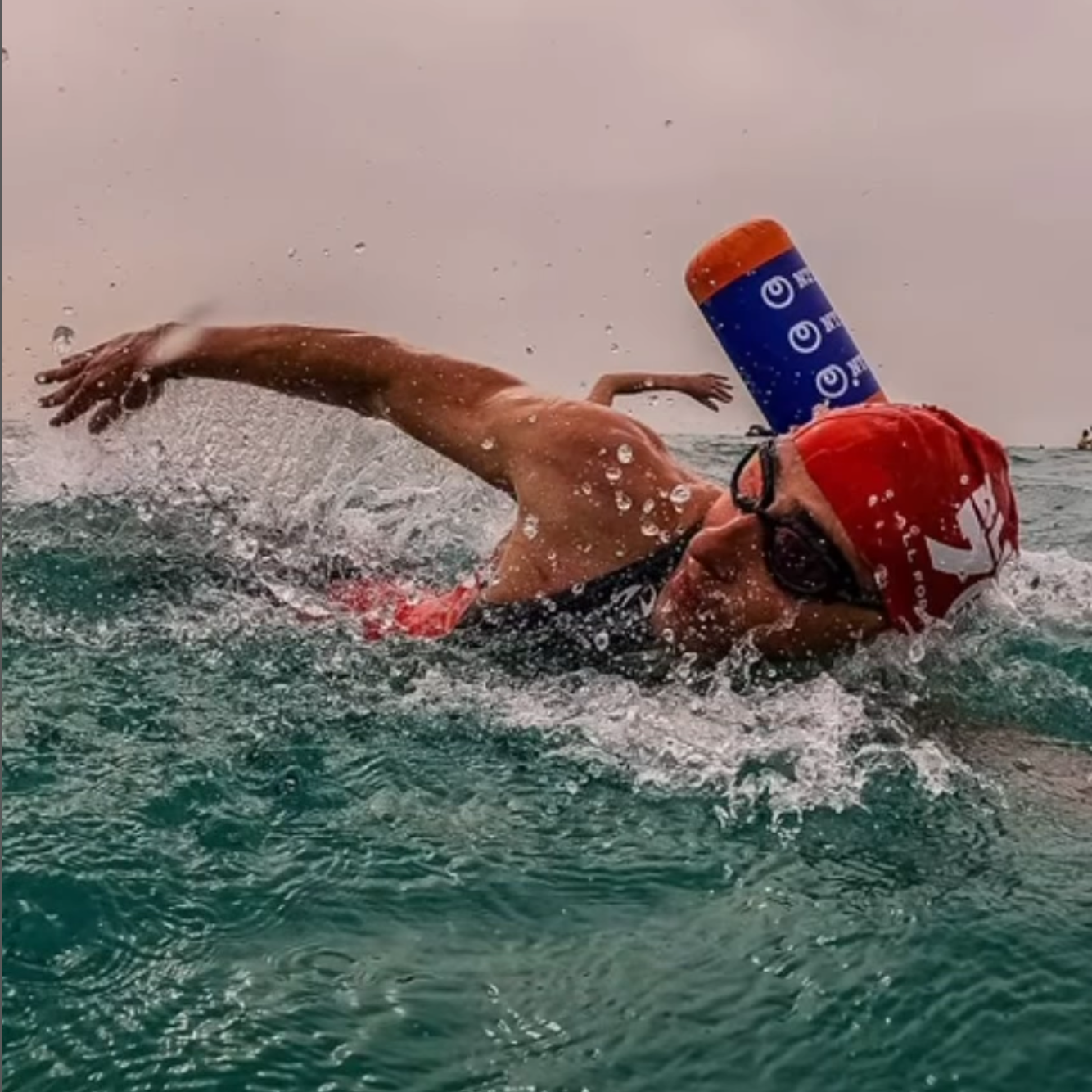
Body position isn't static through a swim. Core and leg fatigue pull the hips down as distance adds up, a pattern well documented in swimming biomechanics. Stroke length shortens. Kick amplitude drops. Swimmers compensate by turning their arms over faster to hold pace, which raises the cost of every meter. Without a wetsuit, this shows up as the familiar mid-race breakdown: hips lower, legs trailing, energy spent fighting drag instead of moving forward.
A wetsuit's buoyancy panels don't clock out when you get tired. They keep lifting your hips and legs whether your core is fresh or fatigued. So the position-correction benefit is smallest early in a swim, when your own position is still good, and largest later, when fatigue would otherwise drag your hips down. Less core work required to hold hip height means more of your remaining energy goes toward moving forward instead of staying level.
Here's the pacing consequence. Swimmers who fade in the second half of an open-water leg, which describes most of us, stand to notice the wetsuit's contribution most in exactly the segment where they'd otherwise be losing time. Judging a wetsuit's benefit off the first 200 meters of a warm-up swim undersells what it does across a full 1,500 or 3,800 meters.
Shoulder flexibility and the cost of each stroke
Position correction is one half of this. The other is what the suit does at the catch and the recovery, stroke by stroke. This is where neoprene cell structure matters. Blue70 builds its wetsuits from Yamamoto neoprene in 38, 39, and 40 cell grades, placing the higher cell counts at the shoulders for greater flexibility. Thinner, more flexible neoprene at the point of rotation means less resistance to the arm moving through its full range. A restricted shoulder shortens your stroke and forces a higher stroke rate to compensate, the same trade-off caused by fatigue-driven position loss, just triggered by a different cause.
The permeable catch panel used on the Helix since 2010 solves a related problem. Thick neoprene across the forearm and hand can dull the feel a swimmer relies on to judge how much water they're moving during the pull. A catch panel that lets water pass through keeps that feedback intact while the rest of the suit handles buoyancy and drag. None of this shows up as one number on a stopwatch. It's the difference between a suit that fights your stroke while helping your position, and one that supports both at once.
Fit decides whether any of this applies
Every mechanism above assumes correct fit. Get that wrong and these benefits shrink or disappear. A suit loose at the hips lets water flush through the buoyancy panels, undercutting the lift they're built to provide. A suit too tight at the shoulders restricts the exact range of motion that thin neoprene up there was designed to allow. A swimmer fighting shoulder restriction tires faster, not slower.
The fit rule is simple: a wetsuit should feel snug, even a little restrictive, standing on dry land, and more comfortable once you're in the water and the suit has taken its working shape against your body. If you've never checked this on your own suit, Blue70's fitting guide walks through the shoulder, torso, and leg points that matter most. The Test Swim policy exists so you can confirm fit in open water, not a changing room, before you commit.
Matching the suit to how you actually swim
How often you train should shape your suit choice as much as race-day ambition does. A suit built from the thinnest, most flexible neoprene, like the Helix, gives the most range of motion but wears faster under frequent training use, since delicate neoprene logs more wear over repeated swims. Swimmers training in open water more than once a week are usually better served by:
- The Reaction, built with a higher-grade neoprene for durability across longer, repeated sessions
- The Fusion, suited to shorter, frequent swims
- The Sprint, a solid entry point while building open-water hours before a heavier training suit
None of this is about buying the most suit you can afford. It's about matching neoprene grade and construction to how many hours that suit will actually spend in the water.
The takeaway
Wetsuit speed gain is real and it's mechanically explainable, but it's not a flat number you quote once and move on from. It's front-loaded toward drag reduction and stroke mechanics early in a swim, and back-loaded toward position correction as fatigue sets in. Want to feel the difference yourself? Get into open water in a properly fitted suit and pay attention to how your stroke feels at minute five versus minute thirty, not just the first hundred meters off the dock.