


Ask most swimmers what makes a wetsuit sustainable and you'll get the same answer almost every time: what's it made of? Petroleum-based neoprene or something else? Recycled lining? It's a fair question. It's also not the whole question - and honestly, it skips the one variable every swimmer actually controls: how long the wetsuit already hanging in your gear bag stays in service.
A wetsuit's environmental footprint doesn't get decided once, at the factory. It gets decided again every single time you rinse it, store it, size it correctly, or pick the right suit for how you actually train. So let's look at sustainability through that wider lens - starting with the material, then moving into the everyday habits that determine whether a suit lasts two seasons or eight.
The Material Story, and Where It Falls Short
Neoprene is a synthetic rubber. Historically it's been made from petroleum feedstock. Over the last couple of decades, though, an alternative production method has become standard in performance swimwear: limestone-based neoprene, built from calcium carbonate instead of crude oil. This is the process behind Yamamoto neoprene, which runs through the entire Blue70 wetsuit line in 38, 39, and 40 cell grades.
That distinction is worth understanding for two reasons.
The first is that it's as much a performance story as an environmental one. The limestone-based process produces a finer, more consistent cell structure, which is part of why higher cell counts - that 40-cell neoprene in particular - flex so freely and keep recovering their shape swim after swim. Performance and lower-impact sourcing didn't end up at odds here. They came from the same decision.
The second is that this is a real shift, but not a finish line. Sourcing rubber from a mineral base instead of a petrochemical one moves part of the supply chain away from crude oil. That matters. It doesn't make any wetsuit carbon-neutral or fully "green," because no current production process gets there - but it's a legitimate distinction, not a marketing flourish, and it deserves to be understood as such.
Where the conversation usually stalls is right here, treating "what it's made of" as the entire story. A wetsuit built with a lower-impact process but tossed after one season isn't a win for anyone. Longevity is the multiplier the rest of this depends on - and it's the part almost nobody talks about.
The Multiplier Nobody Markets: Matching the Suit to the Swim
Here's something worth saying plainly, even though it runs against the instinct to buy the flagship model: the fastest, thinnest, most race-tuned wetsuit is not the most durable one. It was never built to be.
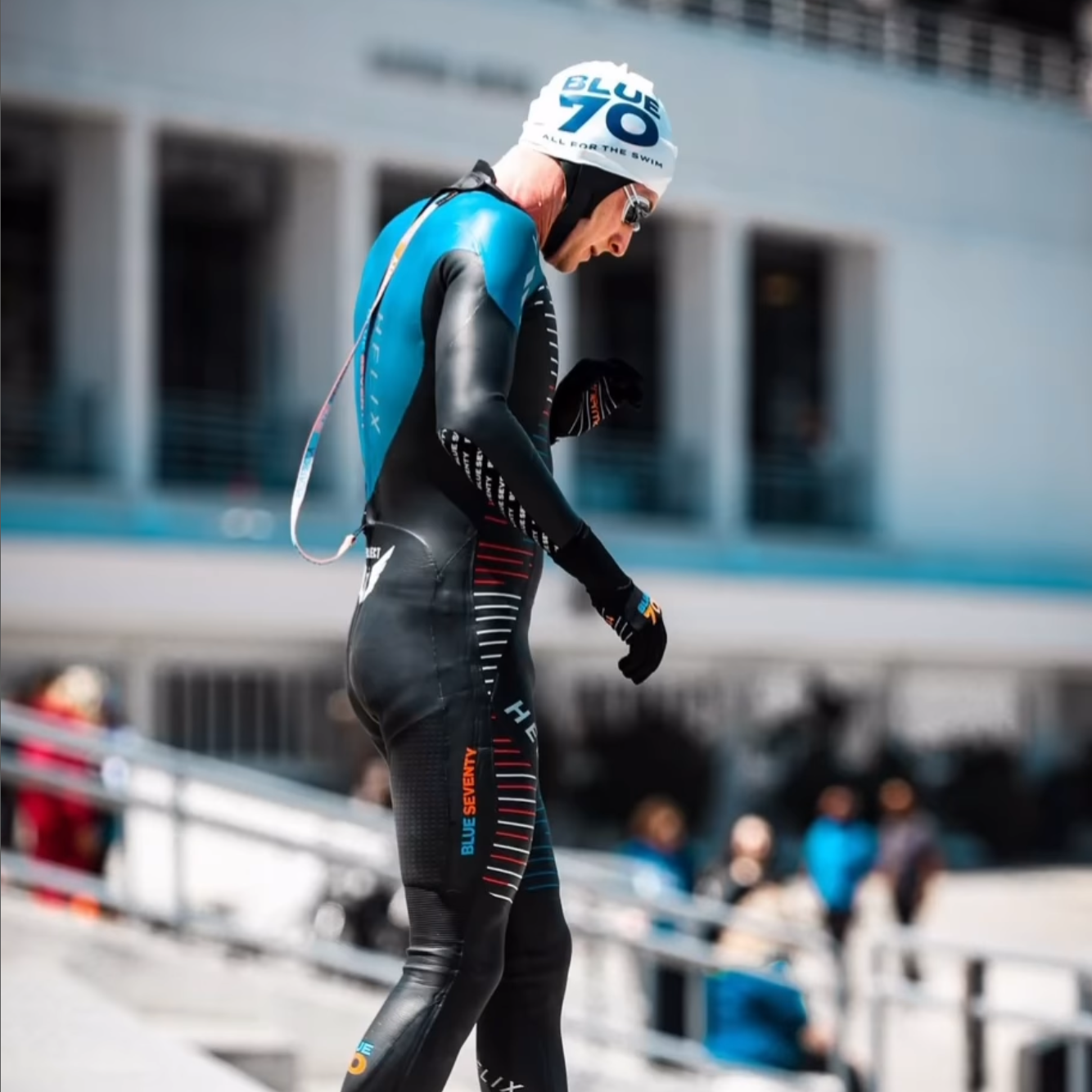
Ultra-thin, high-cell neoprene through the shoulders and arms exists for exactly one reason - to preserve feel for the water and get restriction out of the stroke. That's the whole job of a race suit like the Helix. But that same delicate neoprene wasn't designed to survive twice-weekly open water sessions all season. Ask it to, and it will wear down faster than a suit built with thicker, more training-durable rubber through the high-stress zones. That's not a flaw. It's a trade-off, and it's one worth naming honestly instead of glossing over.
So the sustainable choice often isn't the premium suit - it's the correctly matched one.
- Racing a handful of times a year? A flexibility-first race suit makes sense. You're not asking it to survive fifty training swims, just to perform on a few key days.
- Training in open water once a week or more? Something built with more durable neoprene through the torso and legs - the Reaction or Fusion range - will simply outlast a delicate race suit under that kind of repeated load.
- Building open water experience on a budget? An entry-level suit like the Sprint that actually gets used, week after week, beats an aspirational suit that spends more time being babied in a gear bag than swum in.
Buying for the training week you actually have - not the race-day version of yourself you're picturing - is one of the more underrated sustainability calls a swimmer makes. It also happens to be the better financial call, which is a nice bit of overlap.
Fit Isn't Just About Comfort. It's About Durability.
A wetsuit that doesn't fit doesn't just feel worse - it fails sooner. Too loose through the torso, and it creases and flexes in places it shouldn't, wearing down exactly those stress points faster. Too tight, and it strains seams and neoprene panels every time you reach forward for the catch. Getting sizing right the first time isn't only about comfort. It's about lifespan.
This is also why solving buying anxiety upfront matters more than it seems. Ordering the wrong size, swimming in it once, and shipping it back doesn't do anyone any favors - not you, not the retailer, not the environment. If you're not sure, run through a size chart before ordering. And if you're still unsure how a suit will actually feel once you're moving through open water, take advantage of a policy that lets you swim in it first before committing. Blue70's Test Swim policy exists for exactly this - it won't affect your ability to exchange or return. Getting it right the first time is the unglamorous, quietly sustainable version of buying a wetsuit.
The Small Habits That Add Years
Most wetsuit damage isn't dramatic. It's incremental, and almost all of it is avoidable. A few habits that genuinely extend a suit's working life:
- Rinse in fresh water after every swim - salt water or chlorine, doesn't matter. Both break down neoprene glue lines and panel bonding over time if left to dry on the suit unrinsed.
- Dry it inside-out, out of direct sun. UV and heat are two of the fastest ways to lose flexibility and start seeing premature cracking.
- Store it flat, or on a wide hanger - not folded for long stretches, which sets permanent crease lines into high-cell neoprene.
- Watch your fingernails and heels. These cause the two most common early-life wetsuit injuries - punctures going in, tears coming out. Both are avoidable with gloves, a plastic bag over the foot on entry, or just slowing down at the two riskiest moments of putting on and taking off the suit.
None of this is complicated. It's also the difference between a suit that's still race-ready in year four and one showing seam separation by the end of its first season.
Repair Before You Replace
When damage does happen, remember a neoprene wetsuit is repairable, not disposable. Small nicks and seam separations can often be fixed with neoprene cement rather than a full replacement - a genuinely underused option. Plenty of swimmers go buy something new when a tube of cement and twenty quiet minutes would have solved the problem.
If you're not sure whether a repair is worth attempting, warranty terms are a useful reference point. Manufacturing or material defects are typically covered for the original owner; damage from fingernails, heat, chlorine, force on a zipper, or non-swimming use generally isn't. Knowing the difference helps you figure out whether a fix is on you, covered, or simply not worth chasing - but it rarely means the suit itself is finished.
Two Swimmers, Same Suit, Very Different Outcomes
Picture two swimmers who bought the identical mid-range wetsuit on the same day. One rinses it after every open water swim, dries it inside-out away from the sun, stores it flat. The other leaves it balled up wet in a gear bag between sessions and lets it dry in direct sunlight on the dock.
Same neoprene. Same construction. Wildly different lifespans. That gap - not the difference between one production process and another - is where most of a wetsuit's real-world environmental impact actually gets decided.
Where This Goes From Here
The wetsuit industry is still early in figuring out sustainability, and it would be dishonest to pretend otherwise. Limestone-based neoprene is a meaningful step on the materials side. But the bigger opportunity - the one available to every swimmer today, no matter what innovation shows up next - is behavioral: choosing the right suit for how you actually train, fitting it properly the first time, caring for it consistently, and repairing instead of replacing when something tears.
The most sustainable wetsuit, in the end, is usually the one you already own - properly fitted, well cared for, and matched to the swimming you actually do.
Not sure your current suit fits the way it should, or whether you're training in something built for racing rather than volume? Check a size chart before your next purchase, and if you're torn between models, take a Test Swim - it won't affect your ability to exchange or return. Getting the fit and the model right the first time is the simplest sustainability decision you'll make all season.
Happy swimming.