


Grab a standard wetsuit size chart and you'll notice something: it assumes your hips, waist, and shoulders scale together. Go up a size, everything gets roomier by the same percentage. Go down, everything shrinks together too. That works fine if your body actually follows that ratio.
It doesn't work for a pear-shaped swimmer. If your hips and thighs run two sizes larger than your shoulders and bust, a chart built on uniform scaling puts you in a bind. Size for the hips and your shoulders swim in loose neoprene, exactly where you need tight control for a full stroke rotation. Size for the shoulders and your hips end up compressed, fighting the suit on every kick.
Neither option is a fit. It's a pattern mismatch, and no amount of sizing up or down fixes it.
Why Grading Breaks Down for Pear-Shaped Bodies
Here's how wetsuit patterns actually get built. A manufacturer designs one base block, then grades it up or down for each size. Chest, waist, hip, thigh, sleeve length: everything scales by roughly the same amount between sizes. That's efficient to manufacture. It also assumes every body wearing that pattern has roughly the same ratio between measurements as the original block.
A pear-shaped body usually has a bigger hip-to-bust ratio than that block assumes. So when you size up to fit your hips, you're not adding volume where you need it. You're adding it everywhere, including your shoulders and upper arms, where it does nothing but create drag.
This is exactly why Femme Fit sizing exists as its own separate pattern, not a men's block scaled down. The design refines fit specifically in the bust, torso, wrists, and ankles. The neckline sits lower, which cuts down on chafing at the collarbone, an area unisex patterns get wrong more often than not. The zipper runs longer too. For a pear-shaped swimmer, that extra zipper length matters: it lets you get the suit over wider hips without cranking the shoulders and neckline tighter to compensate. It also makes for a faster transition.
What Correct Fit Actually Feels Like
Every wetsuit follows the same basic fit rule: snug on land, more comfortable once you're in the water and the neoprene settles against your skin. But "snug" means something different depending on where you're standing on your own body, especially if you're pear-shaped.
Hips and Thighs
Snug here means full contact with your skin, no folding, no bunching. But you should still be able to complete a full flutter kick without the suit clamping down at the top of the upstroke. If you hit a wall of resistance every time your leg extends back, the hip and thigh panels are too small for your frame, no matter what the label size says.
Shoulders and Upper Back
This is where fit should feel almost loose by comparison, and that's not a contradiction. Your shoulder does more rotational work than any other joint in your stroke. Every wetsuit needs enough give there for a full cycle without pulling back on the recovery. Size up purely to fit your hips and you'll often end up with too much slack through the shoulders. Loose neoprene fills with water and flaps. That's drag, not comfort.
Waist
This is where a properly built pattern really shows its value. It should taper in at your natural waist even as it widens again through the hip, instead of running as one straight column from bust to thigh. Get this wrong and you carry extra fabric volume across your midsection that catches water and drags your hips down, which defeats the entire point of wearing a wetsuit in the first place.
How This Plays Out on Body Position
Buoyancy equals speed. That only works if the neoprene sits close enough to your body to lift it as one unit, not in pieces. A suit that fits your shoulders but strains at your hips (or the other way around) doesn't distribute that buoyancy evenly along your length.
Pear-shaped swimmers in a mismatched suit often end up with what feels like a seesaw: shoulders riding high because the upper panels fit well, hips sitting low because the lower panels aren't doing their job. It matters more here than for other body types, simply because more of your mass sits below the waist. Support that mass correctly, without squeezing it, and your body position improves more than it would for someone whose weight sits more evenly along the torso.
How to Actually Check Your Fit
- Measure hip and bust separately. Don't average them. If they land in different size categories, look for a pattern built with graduated proportions, like Femme Fit, rather than splitting the difference on a single size.
- Test your shoulder range before anything else. Suit on, arms overhead, rotate through a full freestyle motion on dry land. Pulling across your upper back before your hips complain at all means the suit is wrong in the wrong place.
- Check the zipper and neckline together. The longer zipper should let you clear your hips without forcing the neckline too tight at your throat.
- Let the water decide, not the mirror. A suit can look fine standing in your living room and still reveal a pinch point the second you start swimming. Take a Test Swim in it. If it's not right, it can still be exchanged within 30 days as long as it comes back clean, dry, and with tags attached.
- Resist the urge to size up for hip comfort alone. If a full size up is the only way to fix your hips, that's telling you the pattern is wrong, not the size. A well-built pattern keeps you in your correct torso size while still giving your hips and thighs room.
Why This Matters Beyond Comfort
For anyone training in open water regularly, kick mechanics depend on unrestricted hip flexion. Small amounts of added resistance at the top of every kick add up over an hour-long swim. A suit built to leave your hips and thighs free, without over-compressing them, helps you hold kick tempo later into a long session.
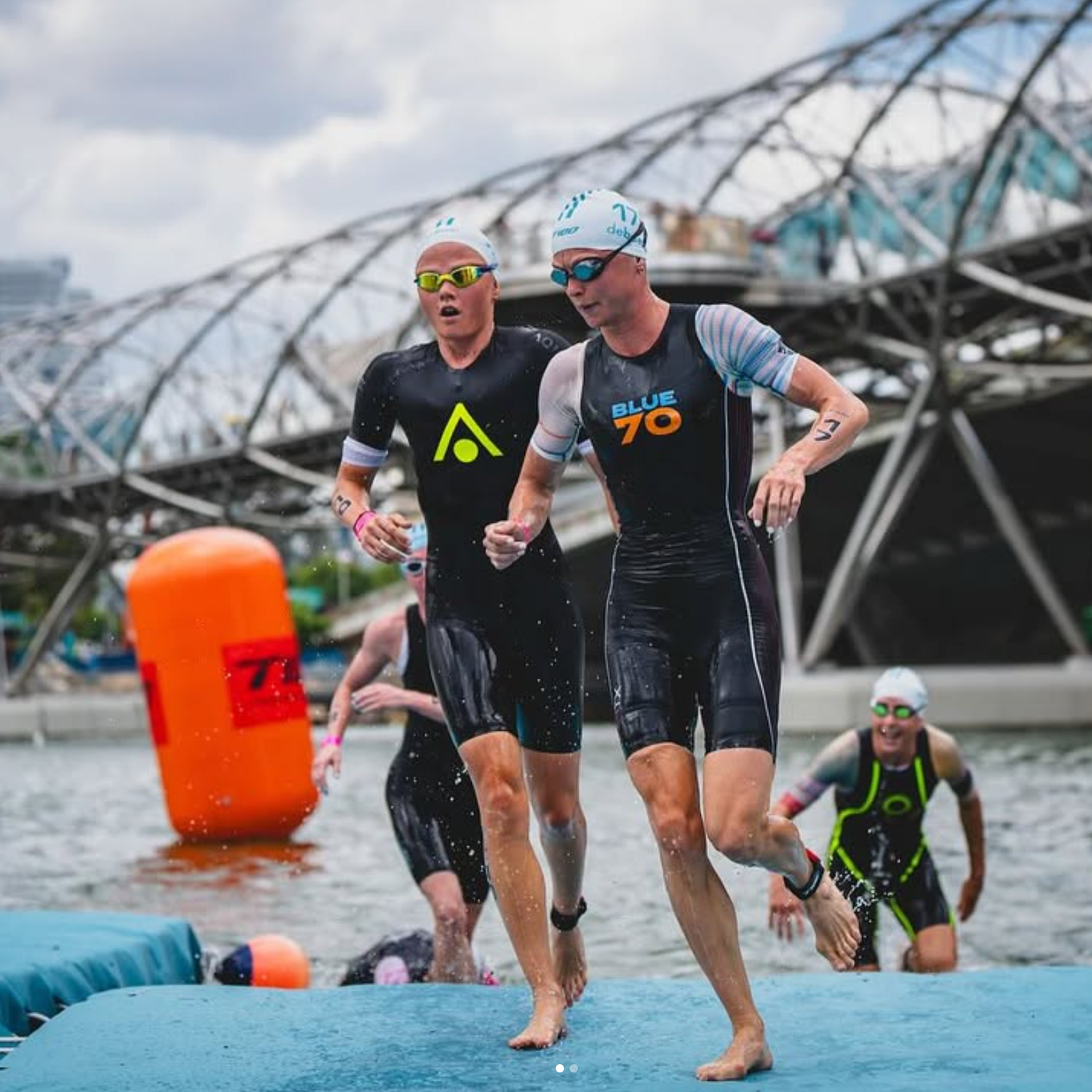
Race day adds a second, more literal payoff. A longer zipper built for wider hips comes off faster in transition, because there's less friction dragging neoprene over your hip on the way out. That's a stopwatch reason to get this right, separate from how the suit feels while you're swimming in it.
Pattern Beats Size, Every Time
A pear-shaped swimmer doesn't need a smaller version of a suit built for a different body. She needs a pattern built around the actual ratio between her hips and her shoulders, not a single size number stretched to cover both at once. That's the thinking behind Femme Fit: not a resized men's block, but a design built from the ground up around a female frame.
If you're not sure whether your current suit fits your hips and shoulders correctly at the same time, there's really one way to find out. Get in the water, swim a few hundred meters, and pay attention to where the suit is working with you and where it isn't. A chart can only tell you so much. Your stroke will tell you the rest.