


Most swimmers judge a wetsuit too early. They pull it on, stand in front of a mirror, swing their arms once or twice, and decide if it feels comfortable. That works for a sweatshirt. It does not work for a swim-specific wetsuit.
A swimming wetsuit is built for a body that is stretched long and horizontal in the water, not upright on dry land. That is why a good suit often feels tighter than expected at first. The better question is not whether it feels easy while standing still. The better question is whether it lets you swim well.
If the fit is right, the suit should feel snug on land and more natural in the water. It should stay close to the body, support your position in the water, and allow your stroke to stay clean. If it feels roomy before you get wet, it is often too big. If it pulls hard on the shoulders or limits reach after you have adjusted it properly, it is too small or sitting in the wrong place.
Why wetsuit fit is really a stroke question
Fit gets discussed like a sizing issue, but in swimming it is also a mechanics issue. A wetsuit changes how you ride in the water. It affects rotation, reach, body position, and how much effort you spend holding good form over the length of a race or training swim.
That is why the right fit matters to a first-time triathlete and to an experienced open-water swimmer in different ways. One swimmer is trying to feel stable and calm. The other is trying to preserve rhythm, timing, and efficiency at race pace. Both need the same basic thing: a suit that stays connected to the body without getting in the way.
Blue70’s guidance is simple and accurate. A wetsuit should feel snug on dry land and more comfortable in the water. That is the baseline. From there, the next question is how that fit shows up in the stroke.
How tight should a wetsuit actually feel?
It should feel close and secure, not casual and not painful.
You want firm contact through the torso, hips, legs, and neck seal, but you do not want sharp pressure points or a feeling that your shoulders are trapped. A well-fitted suit should feel like it is wrapping the body. It should not feel like it is hanging off you, and it should not feel like it is cutting your stroke short.
That balance matters because wetsuits are designed to let in a thin layer of water, which your body warms for insulation. They are not waterproof, and they are not supposed to keep you dry. If too much water moves through the suit, the fit is loose enough to hurt both swim feel and thermal protection.
The most useful fit test: does your stroke still feel like your stroke?
This is the standard many swimmers miss. They focus on pressure, but they do not pay enough attention to movement.
A good wetsuit should support your swimming without rewriting it. Your reach should still feel long. Your rotation should still feel balanced. Your catch should still feel connected. The suit should help body position and reduce drag, but it should not force you into a shorter, choppier stroke just because the shoulders are under too much load.
If a suit changes your mechanics in a bad way, the fit is off. That can happen in two directions.
When the suit is too tight
A too-tight suit usually shows up first in the shoulders and chest. You reach forward and feel resistance before the hand even enters the water. Over time, that can shorten the front end of the stroke, increase fatigue, and make it harder to hold clean timing during sighting, surges, or buoy turns.
Sometimes the size is wrong. Sometimes the problem is simpler: the suit has not been pulled high enough through the legs, hips, and underarms. When the lower half sits low, the shoulders pay for it every stroke.
When the suit is too loose
A loose suit creates a different set of problems. Water moves more freely through the torso, lower back, and legs. The suit can shift during rotation or pace changes. Body position support becomes less consistent, and the whole system feels less stable.
This is why a roomy first impression can be misleading. A wetsuit that feels easy in the mirror can feel disconnected in open water.
What each part of the wetsuit should feel like
Neck
The neck should sit close to the skin and create a seal without harsh pressure. You should be able to turn your head and mimic sighting without feeling like the collar is choking you. Blue70’s Fusion redesign in 2021 added a lower-sitting neckline for comfort while preserving a watertight seal, which tells you what good neck design is trying to do: seal well and disappear during the swim.
Torso and hips
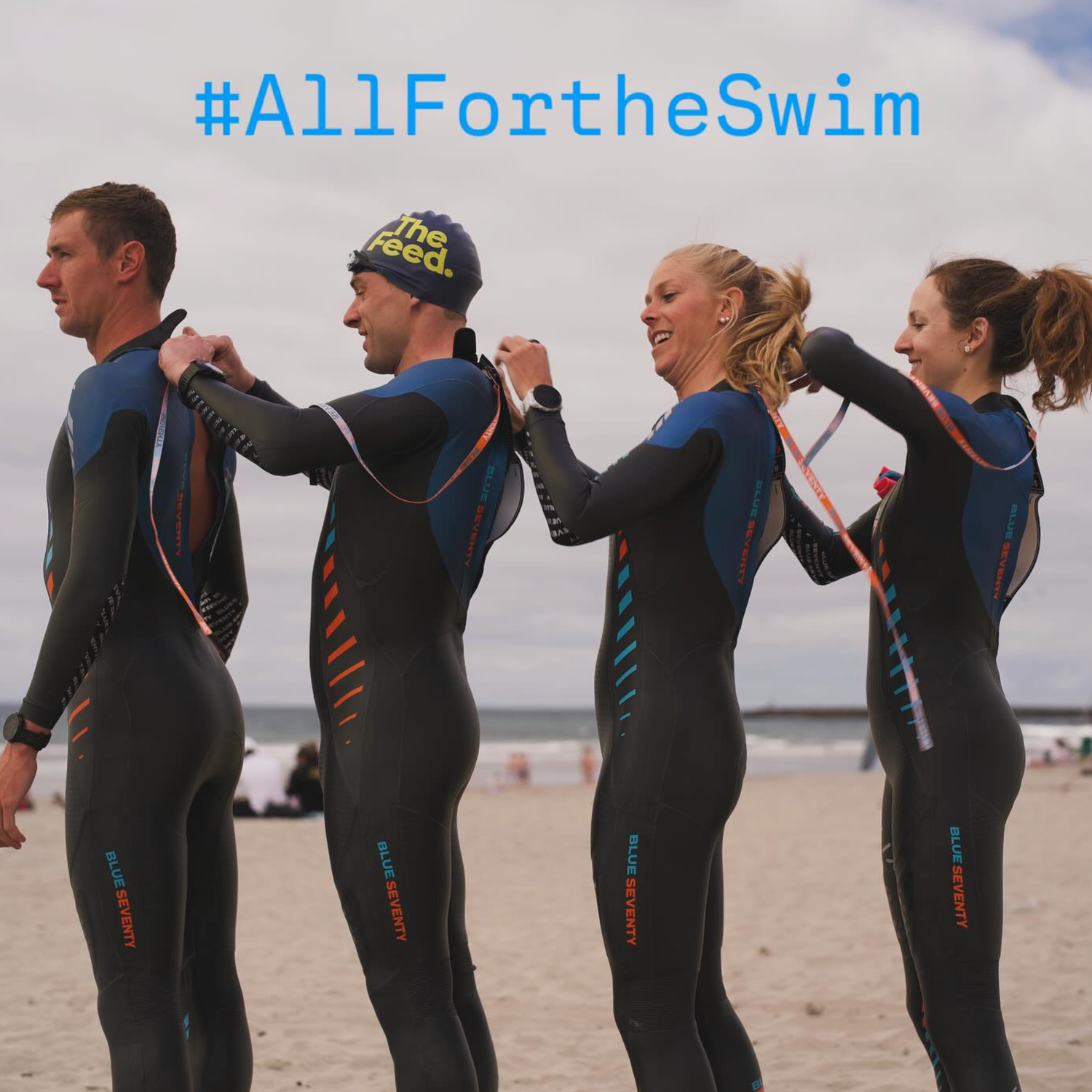
This area should feel secure and smooth. If you can grab large folds of material around the waist or lower back, the suit is too big. A clean fit through the torso helps the suit stay stable as you rotate and change tempo.
Shoulders and underarms
This zone matters most. Blue70 wetsuits use Yamamoto neoprene in 38, 39, and 40 cell, with the higher cell numbers bringing more flexibility. That matters where swimmers notice it first: in the shoulders and arms. The goal is freedom from restriction, not looseness.
If your arms feel heavy or pinned after the suit is fully adjusted, treat that as a fit warning.
Legs and ankles
The legs should fit close without major wrinkles or trapped pockets of air. Bunching behind the knees or looseness at the ankles usually points to a fit or donning problem. It can also make wetsuit removal less clean in transition.
Why wetsuits often feel better once you swim
Standing in neoprene is awkward. Swimming in it is different. Once you are horizontal, the pressure shifts, the suit settles, and the materials move the way they were designed to move.
That is why a wetsuit that feels tight on land can feel correct in the water. It is also why a dry-land try-on is only the first step.
Blue70’s Take a Test Swim policy is useful for exactly this reason. You can swim in the wetsuit and still return or exchange it, provided it comes back clean, dry, unmodified, with tags and accessories. If you are uncertain between sizes, that in-water check tells you more than ten mirror checks ever will.
Dry-land signs that the fit is right
- The suit takes effort to put on, but you do not feel stuck
- The material is pulled high through the legs and hips
- The crotch sits up where it should, not low and sagging
- The torso lies flat through the ribs and lower back
- The underarms are seated properly
- The neckline seals without sharp pressure
- Your arms can reach overhead once everything is adjusted
- There are no large wrinkles behind the knees, in the lower back, or under the arms
In-water signs the fit is wrong
Too tight
- Your shoulders tire early
- Your normal reach feels shorter
- Breathing feels restricted before your effort level explains it
- Sighting makes the neck feel harsher
Too loose
- Water flushes through the suit during pace changes
- The lower back feels baggy
- The suit shifts when you rotate
- The legs or torso feel disconnected from the body
Fit depends on how you swim
First-time triathletes
Newer swimmers often get a lot from the body-position support a wetsuit provides. Blue70’s guidance notes that beginners gain proportionally more from wetsuit buoyancy than advanced swimmers. For that athlete, a good fit should feel supportive and calming, not restrictive. Shoulder tension is the last thing a first-time open-water swimmer needs on race morning.
Frequent open-water swimmers
If you swim outside once a week or more, fit has to hold up over repeated use and longer sessions. This is where honest model selection matters. Blue70 is open about the tradeoff: the Helix is built for race-day performance and uses very thin, flexible neoprene in the arms and shoulders, but that thin neoprene is not ideal for heavy training use. Frequent swimmers often do better in the Reaction for longer swims or the Fusion for shorter frequent sessions.
That is part of fit, too. A suit has to match your body, and it has to match your usage.
Performance-focused racers
Experienced racers notice smaller changes in timing and feel for the water. They are more likely to feel when a suit disrupts catch pressure or slightly shortens extension. For that swimmer, the right fit should feel precise. Close, fast, and quiet in the stroke.
Water temperature changes what you notice
Temperature does not change your size, but it changes what stands out once you start swimming.
Blue70’s published guidance puts the cold-water threshold for a purpose-built thermal suit at about 56 to 58°F. Below that, the Thermal Reaction adds thermal protection with its full Zirconium jersey lining. In colder water, swimmers often focus first on exposure comfort and overall body feel.
At the other end, Blue70 notes that above about 70 to 72°F, a full suit can feel too warm over longer swims, which is where sleeveless suits or swimskins can make more sense depending on the workout and the event rules. [VERIFY: current sanctioning-body rule]
Warm water tends to reveal shoulder restriction faster. If a full suit already feels borderline during a dry fitting, you will notice that sooner in warmer conditions.
Common mistakes swimmers blame on size
Not every bad fit is a bad size. A lot of problems start with setup.
- The suit is sitting too low. This is the biggest one. Low legs and hips create false shoulder restriction.
- The torso was never smoothed out. Folds and slack in the lower back change how the suit feels in the water.
- The swimmer judged the neck too soon. Neck pressure often changes after the upper body is fully adjusted and zipped.
- The loosest option got picked for comfort. That often costs better body position and control in the water.
- The decision was made for transition only. Easy removal matters, but swim performance matters first.
A better try-on routine
- Pull the suit up gradually from the ankles to the knees.
- Work the material high through the hips.
- Seat the crotch fully up into place.
- Smooth the torso through the ribs and lower back.
- Lift material into the underarms.
- Zip the suit and settle the neckline.
- Reach overhead, rotate, and turn your head as if sighting.
Take your time here. A rushed try-on creates bad conclusions.
Why women-specific patterning matters
For many women, the question is not only how tight the wetsuit should be. The question is where it is tight, and why. If the pattern is wrong, swimmers often size up to escape pressure that should not be there in the first place.
Blue70’s Femme Fit design addresses this by refining fit through the bust, torso, wrists, and ankles. It also uses a lowered neckline for comfort and reduced chafing, plus an extended zipper length that makes entry easier, accommodates wider hips, and helps with faster transitions.
That kind of pattern work matters because shape and size are not the same thing.
The short answer
A swimming wetsuit should be tight enough to feel snug, smooth, and secure on land, but not so tight that it changes your stroke once you are in the water.
If the suit seals well, sits high on the body, supports good position, and lets your shoulders move cleanly, the fit is right. If it feels loose and forgiving on land but shifts or flushes once you swim, it is too big. If it loads the shoulders, shortens your reach, or creates pressure that does not improve after adjustment, it is too tight.
The best-fitting wetsuit does not just feel good standing still. It helps you swim the way you want to swim.
If you want to double-check your size before race season, use Blue70’s size charts, review the fit guide, or Take a Test Swim and judge the fit where it counts: in the water.