


It’s the question every first-time wetsuit buyer asks-and honestly, even experienced swimmers second-guess themselves in a new suit. The short answer: a properly fitting swimming wetsuit should feel almost too snug on dry land and then become a second skin the moment you hit the water. But let’s walk through exactly what “fits correctly” means, from the first tug at your ankle to the last stroke of your swim, so you can be confident you’re in the right suit.
It starts on dry land-and it will feel tight
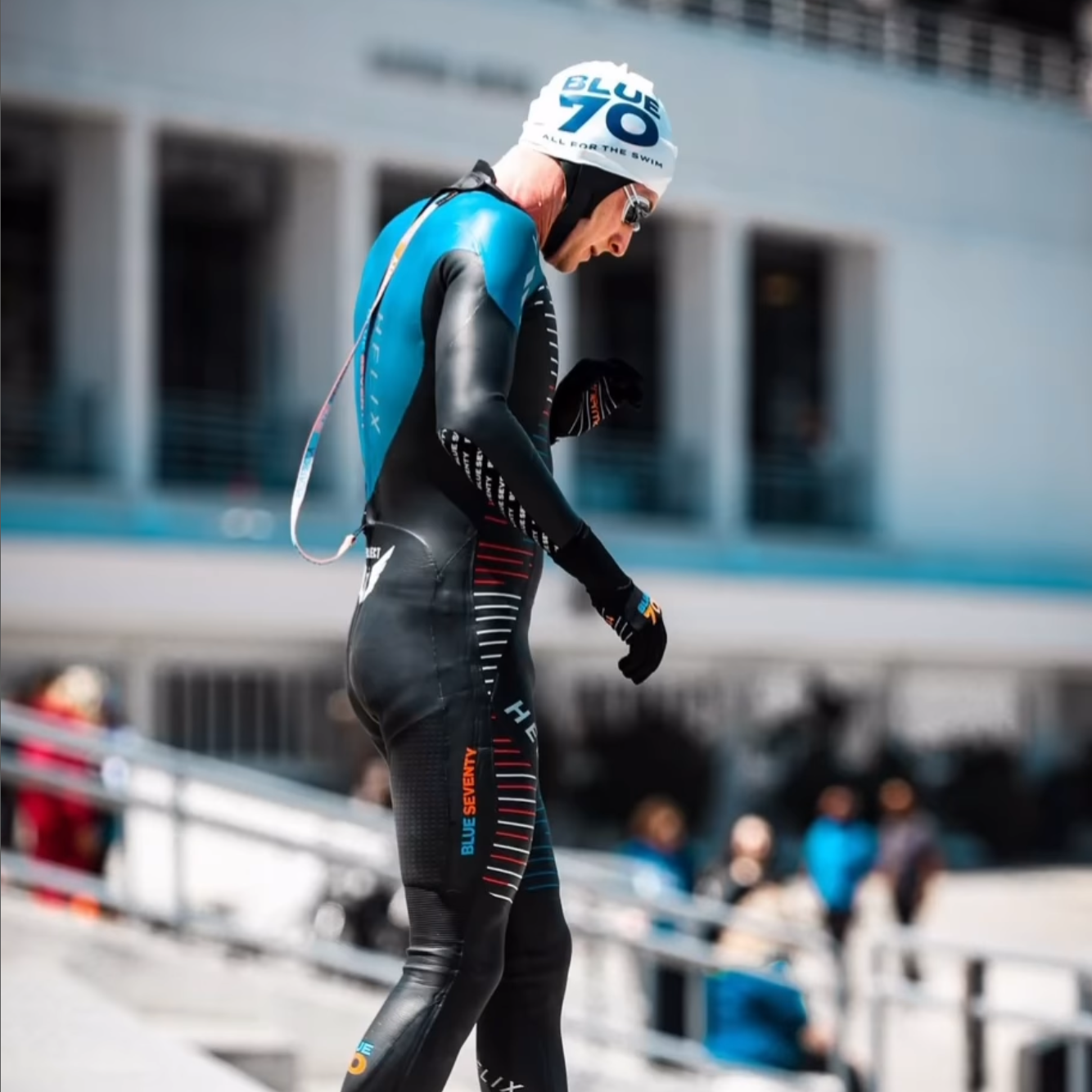
Walk into any swim shop and pull on a blueseventy wetsuit for the first time, and you might think, this can’t be my size. That’s normal. A swim-specific wetsuit isn’t a casual jacket; it’s a performance garment engineered to eliminate excess water and reduce drag. Every blueseventy wetsuit-from the entry-level Sprint to the flagship Helix-is cut from ultra-supple Yamamoto neoprene and patterned to follow a swimmer’s body in motion, not a relaxed standing posture.
On land, expect the suit to feel compressive, especially across the chest and torso. You should be able to breathe into your diaphragm without restriction, but a deep, shoulders-back, stand-up-straight breath might feel a little resisted. That’s the suit doing its job: hugging your torso so that only a paper-thin film of water enters when you get in. If you can take a big, unrestricted sigh of relief, the chest is likely too loose-and that spells drag once you start swimming.
The neck should fit flush but not choke. Blueseventy’s Fusion, redesigned in 2021, features a slightly lower-sitting neckline that maintains the seal while reducing that “grabbing” sensation some swimmers dislike. You should be able to swallow and turn your head without a sharp pressure point. A small gap at the neck means water will flush through the suit; too tight and you’ll be distracted the entire swim.
Shoulder freedom is the real test
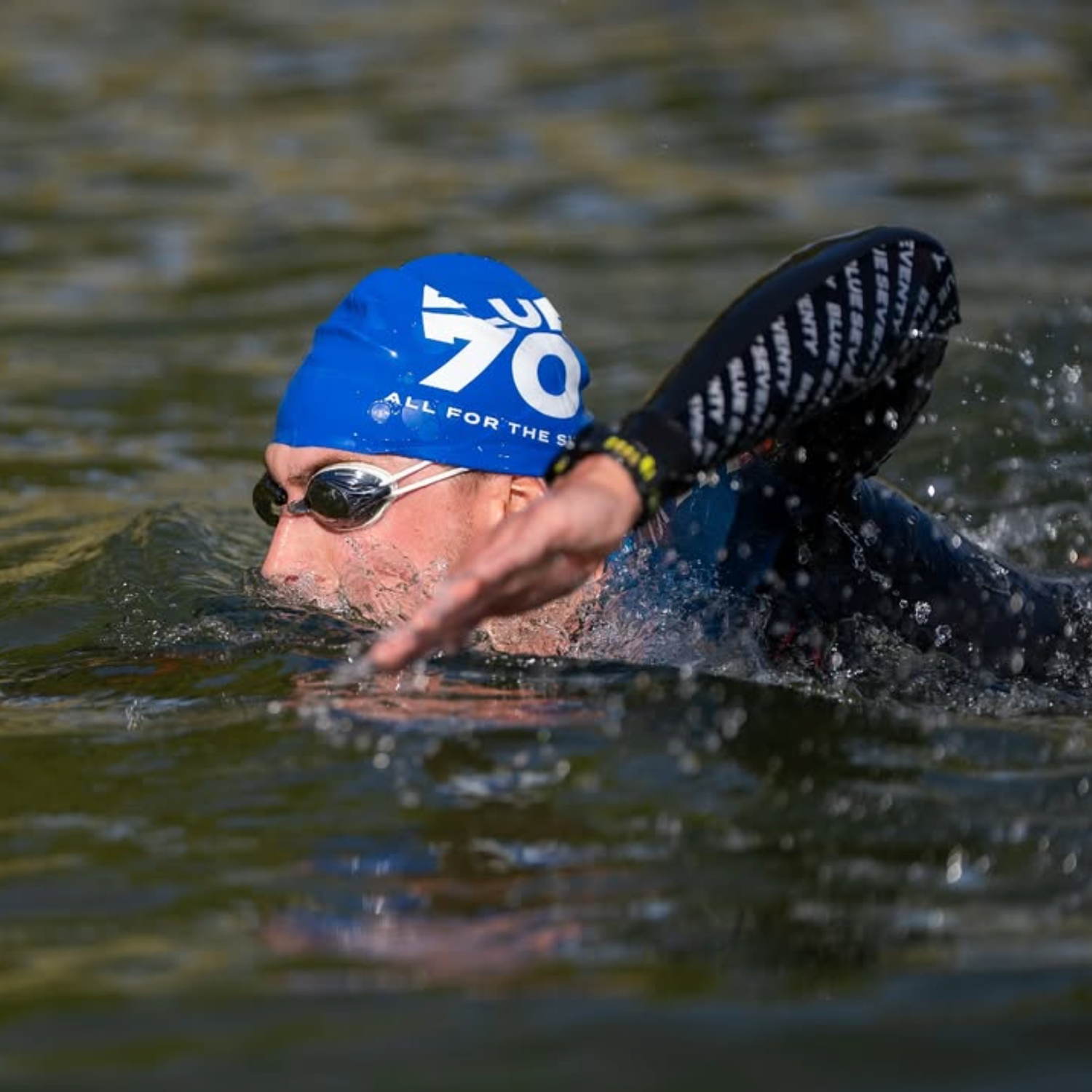
A wetsuit can feel snug through the body and still be completely wrong if it restricts your shoulders. Here’s the test: raise both arms overhead like you’re in a streamlined position. Then slowly mimic a freestyle catch-reach forward, pull down, recover. The suit should move with you, not fight you. If you feel the neoprene binding across your upper back or digging into your armpits, the suit is either too small or not pulled up high enough on your torso.
Blueseventy builds progressive flexibility into its suits specifically for this reason. The Helix and Reaction use higher-cell Yamamoto neoprene (39 and 40 cell) in the arms and shoulders, giving you more stretch where your stroke demands it. Even our more durable Fusion uses a carefully graded panel layout to protect your range of motion. But the most flexible neoprene in the world can’t compensate for a suit that’s the wrong size or simply not donned properly.
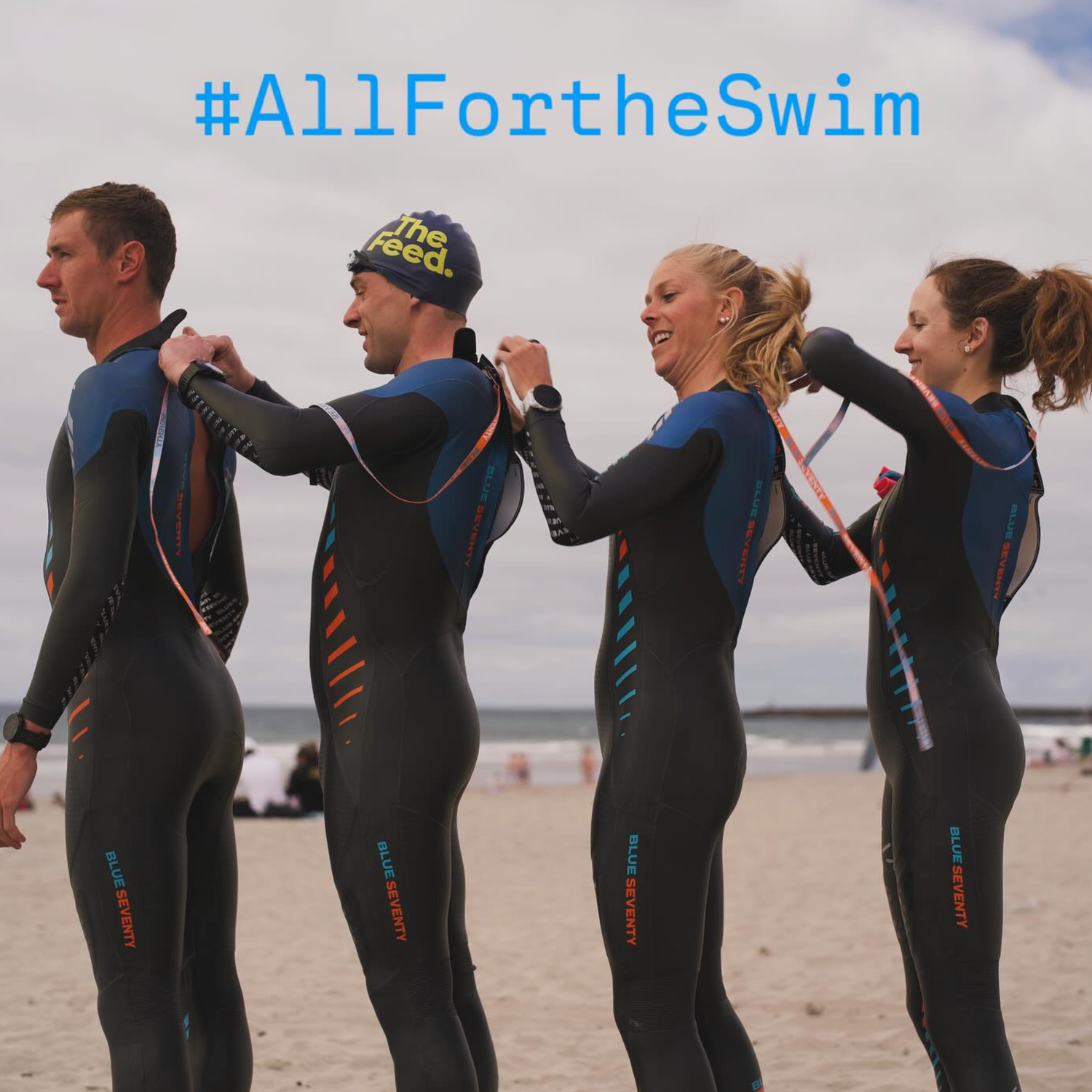
Many shoulder complaints come down to one simple fix: the suit isn’t on all the way. When you first pull it on, grab the neoprene at the thighs and work any excess material upward, inch by inch, until the crotch of the suit sits snug against your body. Then do the same from the torso, pulling up toward the shoulders. Only then should you zip up. A common mistake is zipping too early, which locks the suit in a bunched position and puts immediate strain on the shoulders. Take an extra 60 seconds to gradually lift the legs and torso-you’ll feel the difference immediately.
The “second skin” moment happens in the water
This is why blueseventy strongly encourages every customer to Take a Test Swim. Standing in your living room only tells half the story. Once you enter the water, the suit will relax slightly as the thin layer of water inside warms to your body temperature. The neoprene becomes more pliable, and that land-based tightness transforms into a supportive, body-lifting embrace.
In the water, a correctly fitting swimming wetsuit should:
- Allow a slight trickle of water in-but not a gush. If you feel cold water rushing down your back or pooling around your hips, the neck or zipper seal isn’t tight enough.
- Float your hips and legs without making your feet feel like they’re popping up uncontrollably. Blueseventy’s buoyancy profiles are tuned for swimming: enough lift to put you in a horizontal, energy-saving position, but not so much that you lose connection with the water. If you feel like you’re fighting the suit to get your legs down, you might be in a size too small in the lower half, or you’re in a model with more buoyancy than your stroke currently needs.
- Let you rotate freely. A good suit disappears during body roll. If you feel like you’re strapped into a board, the fit or sizing needs attention.
- Never cause chafing behind the neck, under the arms, or at the wrist and ankle cuffs. Blueseventy’s Femme Fit line, available across every women’s wetsuit, specifically addresses these friction zones with lowered necklines and refined wrist and ankle openings-so if you’re a female swimmer still experiencing hot spots, it’s a strong sign that a unisex cut has been the issue, not wetsuits in general.
Spotting a suit that’s too big or too small
Too big:
- Excessive bunching behind the knees, lower back, or armpits.
- Water flushing noticeably through the neck with each stroke.
- The suit feels baggy or heavy in the water, with a sensation of carrying the suit rather than being lifted by it.
- Sleeves that fill with water or cuffs that don’t seal around your wrists.
Blueseventy wetsuits are designed to be snug to keep water transfer to a minimum. If you can pinch an inch of loose neoprene across your core once the suit is properly on, it’s likely the wrong size.
Too small:
- Red marks and deep impressions that don’t fade quickly after removing the suit (especially around the neck).
- Restricted breathing even when you’re standing still and relaxed.
- Shoulders that fatigue within the first few hundred meters because you’re fighting the suit’s tension on every recovery.
- A zipper that’s impossibly hard to close even when you’ve worked all the material upward. (Blueseventy zippers are robust, but they aren’t meant to be stretched into submission.)
Remember, a wetsuit that’s too small won’t just be uncomfortable; it’ll cost you speed and energy. You’ll end up shortening your stroke and losing your catch because your body is compensating for the restriction.
Female athletes: Femme Fit changes the equation
If you’ve ever felt like your wetsuit fit everywhere except across the bust, hips, or neck, you’re not imagining things. Blueseventy’s Femme Fit line is patterned specifically for women’s bodies-with refined cuts through the bust and torso, an extended zipper for easier entry and faster transitions, and a lowered neckline that dramatically reduces chafing. With up to 15 size options (and multiple height variations within some sizes), Femme Fit means you can nail the fit in all three critical zones-shoulders, torso, and legs-rather than compromising one to accommodate another. If you’re female and consistently between sizes in unisex suits, start with a Femme Fit model like the Fusion or Reaction in your measured size, and you’ll likely find the “snug but not suffocating” balance much more easily.
Between sizes? Here’s the tiebreaker.
Blueseventy’s size charts cover height and weight ranges, but no chart can account for every body shape. If your measurements land you right on the line between two sizes, focus on the fit priority:
- Competitive swimmers and triathletes who prioritize every bit of drag reduction should go with the smaller size, provided the shoulder test passes and breathing is comfortable.
- Open water swimmers logging long, steady miles or those new to the sport often prefer the slightly more forgiving upper body of the larger size, which translates to less fatigue over an hour-plus in the water.
- If the top and bottom of your body map to different sizes, call or email our support team at us@blueseventy.com. In many cases, the correct size is the one that fits your torso and shoulders properly-lower-body tightness can often be managed with careful donning, but upper-body restriction can’t be fixed.
The ultimate confidence check: your Test Swim
Because blueseventy backs every wetsuit with a 30-day return and exchange policy-yes, even after you’ve swum in it-you can verify fit without risking your investment. The suit needs to come back clean, dry, and with tags attached, but a Test Swim isn’t just allowed; it’s encouraged. Take a short, easy swim. Pay attention to breathing, shoulder fatigue, water entry, and whether you feel supported or strained. If something’s off, you can exchange it for a different size and try again. That’s the best way to know your suit fits correctly-not by reading about it, but by swimming in it.
Dive in and find your perfect fit. Browse our complete wetsuit range and size charts at blueseventy.com, or email us directly for sizing guidance. Happy swimming!