


For many pregnant swimmers, yes, but only after your midwife or obstetrician clears you for open water swimming. A wetsuit can give you warmth, buoyancy, and a more comfortable body position. It cannot make swimming risk-free, and it is not a Coast Guard-certified personal flotation device.
This article is general information, not medical advice. Your care team knows your pregnancy, your blood pressure, your exercise history, and your local water conditions. Start there.
Get medical clearance first
Pregnancy changes your circulation, core temperature regulation, balance, and lung capacity. Open water adds cold water, currents, boat traffic, and distance from shore. Ask your clinician specifically about cold water immersion and wetsuit compression across your chest and abdomen. If they clear you for open water swimming, a properly fitting suit becomes an equipment question, not a medical one.
Fit changes with your body
Your wetsuit size is not your pre-pregnancy size. Start with your current measurements. Measure your bust, waist, hips, and torso right before you order or try suits.
Blue70 women's suits use Femme Fit, with patterns adjusted in the bust, torso, wrists, and ankles, plus an extended zipper for easier entry and more room through the hips. A suit that is too tight across the ribs or belly can restrict breathing and feel claustrophobic. A suit that is too loose lets water flush through and reduces thermal protection. For many pregnant swimmers, sizing up from the chart based on current measurements works better than guessing from an old size. The suit should feel snug but not painful on land. In the water it should settle without pinching.
How a wetsuit helps in the water
Pregnancy shifts your center of mass forward. A wetsuit's neoprene adds buoyancy, especially through the hips and legs, which can help keep your legs higher and reduce drag. This may make your swim feel easier, but it is not a substitute for swim fitness, a safety plan, or a personal flotation device.
Blue70 wetsuits use Yamamoto neoprene in 38, 39, and 40 cell grades. Higher cell count means more flexibility, so the suit can move with you instead of fighting your stroke. That flexibility matters as your reach shortens and your body position changes.
Warmth without overheating
A wetsuit does not keep you dry. It traps a thin layer of water between the neoprene and your skin, and your body warms that layer. In cold water, this provides added thermal protection.
In water above roughly 70 to 72°F, a full wetsuit can become too warm over longer swims, and overheating during pregnancy is a real concern. If the water is warm, a sleeveless Blue70 suit or a shorter swim may be the better call. If you are swimming in water below roughly 56 to 58°F, a purpose-built cold water suit like the Thermal Reaction adds meaningful warmth, but cold water also carries higher risk, so you and your clinician need to decide whether that risk is acceptable for you.
Getting in and out safely
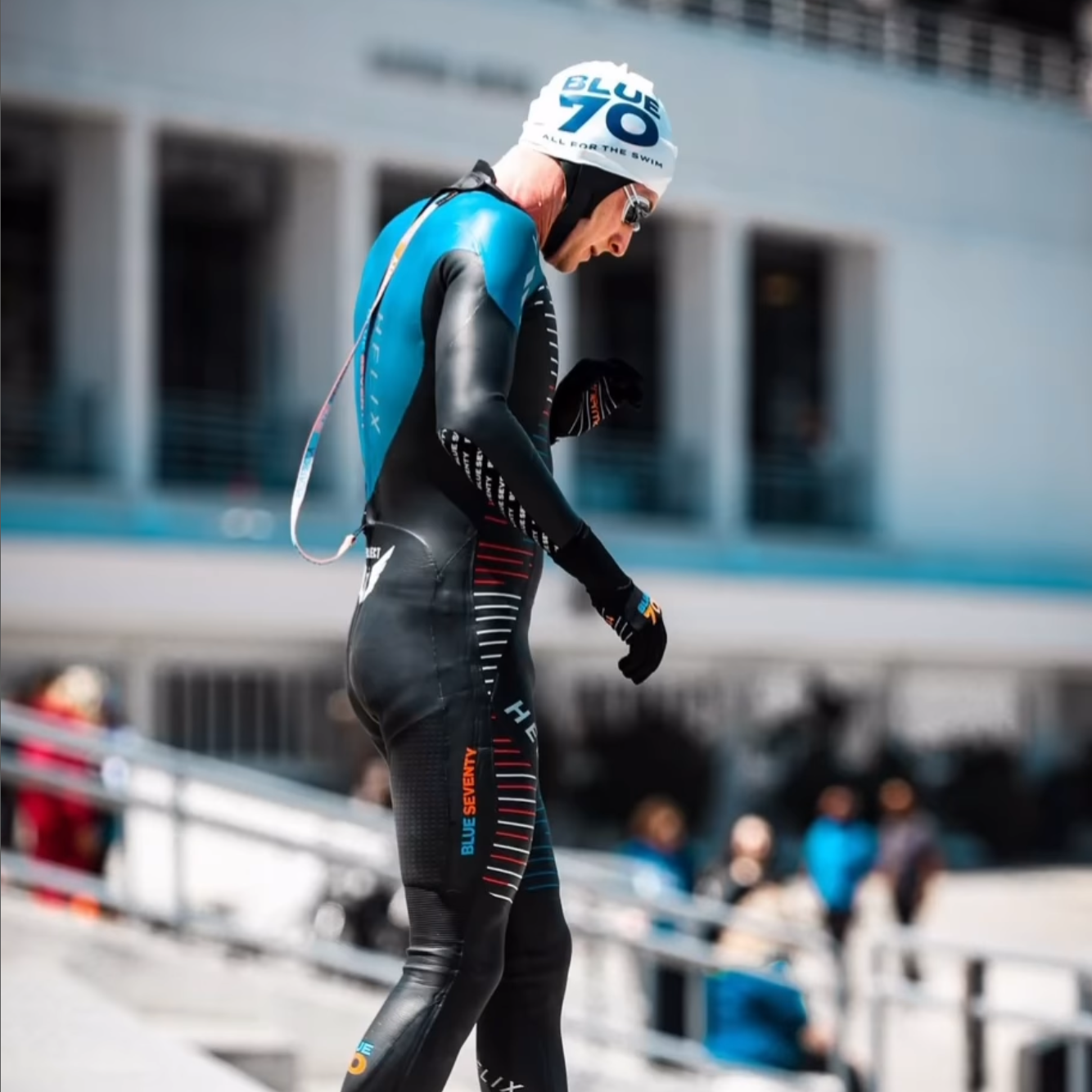
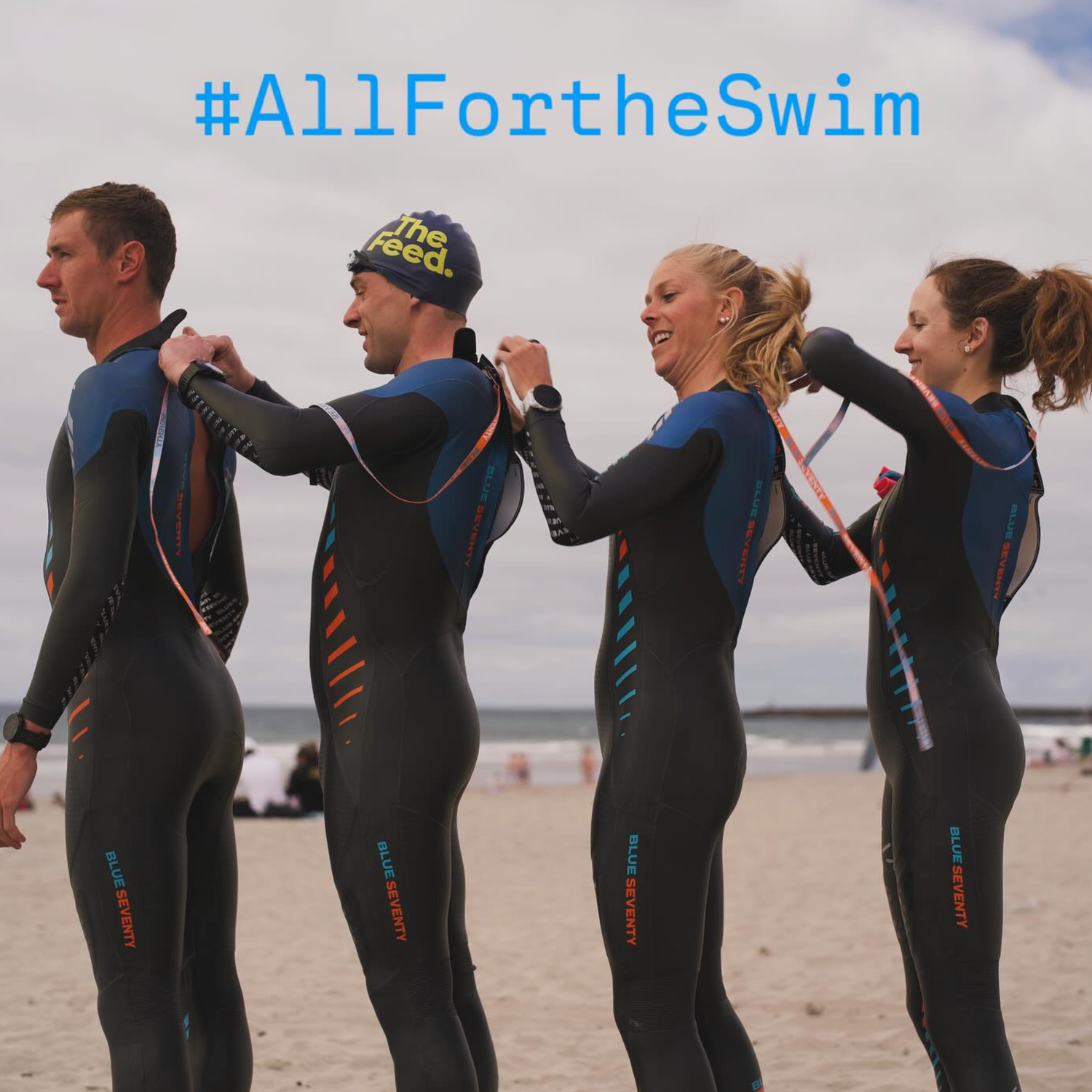
Donning a wetsuit takes more effort as your belly grows. The extended zipper on Femme Fit suits helps with entry and exit. Put the suit on while seated on a stable bench or mat, not standing on one leg near the water. Work the neoprene up gradually, and ask a training partner to check the back zipper if your range of motion is limited.
Before you swim, raise your arms and take a few deep breaths. If the suit squeezes your ribs or you cannot breathe deeply, stop. Size up or try a sleeveless model.
Which Blue70 suit fits the situation
Choose by water temperature and how often you swim.
- Fusion ($420): cooler water and frequent shorter swims, with a lower-sitting neckline that can reduce neck pressure
- Reaction ($680): longer, colder swims, built for frequent use with higher-grade neoprene than the Fusion
- Thermal Reaction ($785): cold water, fully lined with Zirconium jersey for added warmth
- Reaction Sleeveless ($395): less coverage around the arms and shoulders while still giving torso lift
- Sprint ($325): entry-level if you are new to open water swimming and want to keep the investment simple
Test swim and returns
If you and your clinician decide a wetsuit is appropriate, use the Test Swim policy. You can swim in a Blue70 wetsuit and still return or exchange it within 30 days of the ship date, as long as it comes back clean, dry, unmodified, with tags and accessories.
Try the suit in a controlled pool or calm lake before committing. Start with a short swim, stay within easy reach of the shore or a wall, and have a buddy present. Check how the suit feels after 10 minutes. If it digs in at the neck, hips, or ribs, take it off and reassess the size.
Final guidance
If your care team clears you, a Blue70 wetsuit can make open water swimming more comfortable during pregnancy. Measure your current body, choose based on water temperature, and trial the suit in a safe setting. The goal is freedom from restriction, not a tighter suit.
If you need help matching your current measurements to a size, start with the Blue70 sizing tool or email us at us@blueseventy.com.